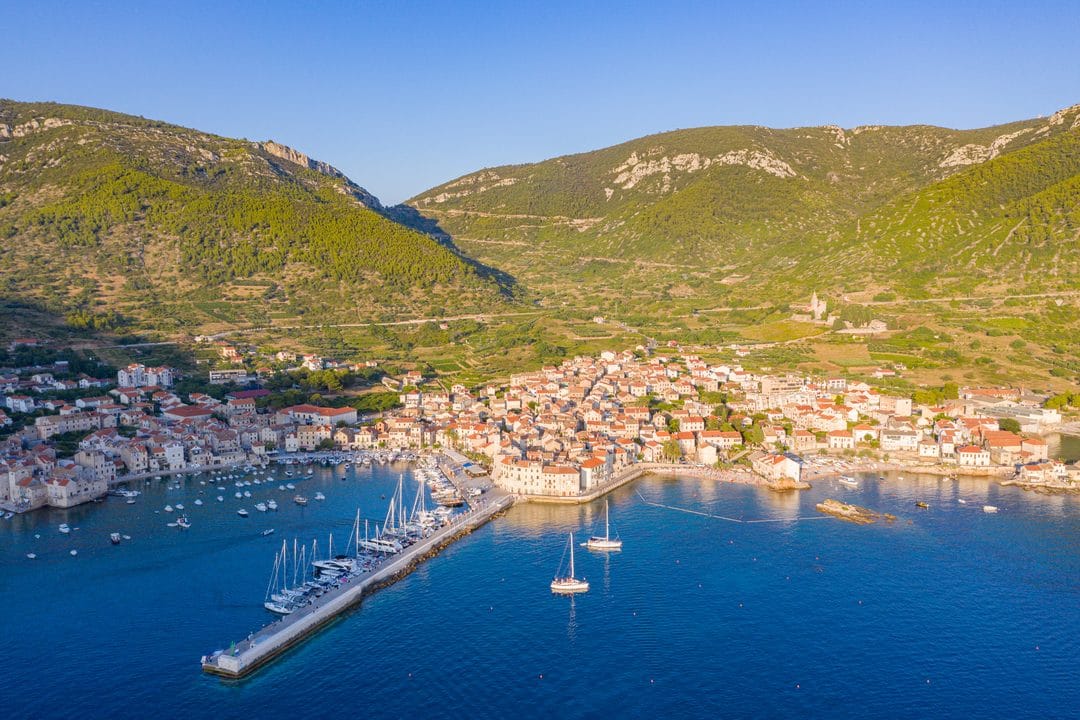
The 8am catamaran out of Split fills up first with day-trippers bound for Hvar, all sunglasses and wheeled cases banging against the gangway, and by the time it pulls away there isn't a spare seat left. Twenty minutes later, at the next stop, barely a dozen people get off for Vis. That gap between the island everyone photographs and the one almost nobody visits is the whole story of Croatia's central Dalmatian coast in July.
Why Hvar fills up and Vis stays empty
Hvar Town's harbour in high summer is a procession of superyachts, and the walk from the ferry to Trg Svetog Stjepana now runs past the same gelato chains and cocktail bars you'd find in Mykonos or Ibiza. None of that is a complaint about Hvar exactly — it earned its reputation with genuinely beautiful medieval streets and a Venetian fortress worth the climb. The problem is capacity. A town built for a few thousand residents now absorbs tens of thousands of visitors a day at the July peak, and prices have followed demand: a simple grilled fish lunch on the harbourfront regularly runs €35–45 per person before wine.
Vis, forty minutes further out by catamaran, was off-limits to any tourism at all until 1989. Tito's Yugoslav navy used it as a military base from the 1950s onward, closed to foreigners and even to most Croatians, with submarine pens dug into the cliffs at Rogač and an airstrip that Yugoslav MiGs used well into the 1980s. That single fact explains almost everything else about the island today. Because outside investors couldn't buy land or build here for four decades, Vis never got the marina developments, the beach clubs or the cruise-ship jetties that reshaped Hvar and Korčula once package tourism took off in the 1970s. When the base finally closed, the island had to more or less rediscover itself as a destination from scratch, and it did so slowly, on its own terms, without ever quite catching up to its neighbours' visitor numbers. Buy your ferry ticket for the same morning departure and you'll notice the difference before you've even left port — the Vis-bound queue is a fraction of the length, and most of the people in it are carrying snorkel gear, not shopping bags.
Getting to Vis: the ferry logistics
Jadrolinija runs the passenger catamaran from Split to Vis Town in around 1 hour 15 minutes, with a one-way ticket typically costing €13–16 depending on season and how far ahead you book. There's also a slower car ferry, closer to two and a half hours, useful if you're bringing a hire car over — worth doing if you want to reach Stončica or the far side of the island without relying on the island's limited bus network. Book the early sailing if you can; the midday and afternoon catamarans in July run close to capacity, and Jadrolinija's online system does sell out on Fridays and weekends. Skip the temptation to wing it on the day — arriving at the port to find the next available crossing is four hours away is not how you want to spend a holiday morning.
Komiža, on the island's west coast, is the fishing town most people picture when they imagine "unspoilt Croatia": stone houses stacked above a curved harbour, nets drying on the quay, and a working fleet that still goes out most nights (the smell of grilled sardines from the harbourside grills at dusk is reason enough to base yourself here). Vis Town, on the east side where the ferry lands, has a different character entirely — it was garrisoned by the British Royal Navy during the Napoleonic Wars, and Fort George, built by British engineers in 1813, still stands above the harbour. Nelson's fleet used the bay as a staging point against Napoleon's forces in the Adriatic, and the British held Vis until 1815, an episode most visitors never hear about because it's barely signposted. Wander up past the old Austro-Hungarian buildings on Vis Town's waterfront and you'll find Roman-era mosaic fragments sitting a few streets back from the fort, with almost no interpretive signage explaining either. That's not a detail many guidebooks mention, and it's one of the few places in Croatia where you'll find a slice of British colonial-era military history sitting quietly alongside Roman ruins and Venetian loggias. Between the two towns, Komiža is the better base if you want harbourside restaurants within walking distance every evening; Vis Town suits travellers who'd rather be near the ferry and don't mind a short bus or taxi ride to the west coast.
What to actually do on Vis
The Blue Cave, or Modra Špilja, is technically on the neighbouring islet of Biševo rather than Vis itself, but every boat trip to see it departs from Komiža, usually as part of a half-day tour that also stops at the Green Cave and Stiniva Cove. Go for the earliest available departure — the cave's famous blue light effect, caused by sunlight refracting through an underwater opening, is strongest between roughly 11am and 1pm, and by early afternoon the tour boats queue up outside the cave mouth in numbers that undercut the whole point of coming.
Stončica, on the eastern tip of the island, has a genuinely excellent sandy-shingle beach and a 19th-century lighthouse that now takes overnight guests — book months ahead if a night in a working lighthouse appeals, because there are only a handful of rooms. Inland, the island's wine is worth building a day around: Vis grows Vugava, an indigenous white variety found almost nowhere else, and Plavac Mali, the same red grape family behind Dingač on the Pelješac peninsula, but grown here on volcanic and limestone soil that gives it a different mineral edge. Small family wineries around Podšpilje and Podhumlje offer tastings for €10–15 that include four or five pours and usually a plate of local cheese and pršut.
For lunch, Konoba Bako in Komiža does peka — meat or octopus slow-roasted under an iron bell with vegetables and embers — but it needs ordering several hours in advance, so ask at breakfast if you want it for dinner. That's the sort of place where the owner will tell you exactly which fisherman brought in today's catch, and you shouldn't expect a menu with photographs or an English translation taped to the wall; that's part of what makes it worth the walk from the harbour.
Lastovo: further out, further behind — in the best way
If Vis feels quiet, Lastovo feels almost abandoned, and that's meant as the highest possible compliment. The island sits roughly 70 nautical miles from Split, was a closed military zone even longer than Vis, and only in 2006 became a protected nature park covering the main island and 46 surrounding islets. Its year-round population is under 700, and the main settlement — also called Lastovo — is built on a natural amphitheatre of a hillside, its houses topped with distinctive round chimneys called fumari that you won't see replicated anywhere else on the Adriatic.
Getting there takes commitment. The direct car ferry from Split to Ubli, Lastovo's port, runs only two or three times a week in summer and takes around five hours; the faster alternative is a ferry to Korčula or Vela Luka followed by a shorter onward hop, which can trim the journey to three hours but adds a connection to manage. Neither option is quick, and that inconvenience is exactly what keeps Lastovo's beaches — Skrivena Luka, Lučica, Saplun — free of the crowds you'd fight for space with on Hvar or even Vis in August.
The catch is that Lastovo's remoteness cuts both ways: restaurant choice is thin, most places close by 10pm, and there's no cash machine glamour or late-night bar scene to speak of. If you want nightlife, this is the wrong island entirely. If you want three days where your biggest decision is which cove to swim at before the only konoba in Skrivena Luka bay serves lunch, it's close to unbeatable.
Where to stay and what it costs
Vis has a handful of proper small hotels — Hotel San Giorgio in Vis Town and Boutique Hotel Kaštel are both well-regarded — with July doubles running €140–220 a night. Private apartments through local agencies are considerably cheaper, often €70–100 for two, and give you a kitchen for the mornings you'd rather not walk into town for breakfast. Lastovo has almost no hotels in the conventional sense; nearly everyone stays in family-run apartments or guesthouses in Lastovo village or down at Skrivena Luka, typically €60–90 a night, booked directly by phone or email as much as through the usual platforms.
Flying from the UK, easyJet and British Airways both run seasonal routes into Split from Gatwick and Manchester, with July return fares commonly landing somewhere between £90 and £160 if booked from spring onward — prices climb sharply for last-minute July departures, so this is not a trip to leave until June. Since Croatia joined the Schengen Area in January 2023, there's no border check travelling onward overland into Slovenia or Italy, but UK passport holders arriving directly from outside Schengen will go through the EU's Entry/Exit System at Split Airport, which now logs biometric data on first arrival rather than a simple passport stamp.
Planning a week that includes both islands
Five nights on Vis and two on Lastovo is a workable split for most travellers, with a base in Komiža or Vis Town for easy access to Biševo boat trips and one dedicated night on Lastovo purely for the sake of seeing it, rather than trying to properly explore both in under a week. Trying to island-hop between all three — Hvar, Vis and Lastovo — in seven days generally backfires; the connections aren't frequent enough, and you'll spend more time on jetties checking timetables than in the water.
July 2026 sits at the edge of the Croatian coast's true peak, with the last two weeks of the month and all of August considerably busier and pricier than the first three weeks. Book the Split–Vis catamaran and any Lastovo accommodation at least six to eight weeks out if your dates are fixed, and treat the Blue Cave trip as the one non-negotiable booking to make in advance — everything else on Vis can be arranged once you're there, over a coffee in Komiža harbour, at a pace that Hvar simply doesn't allow any more.