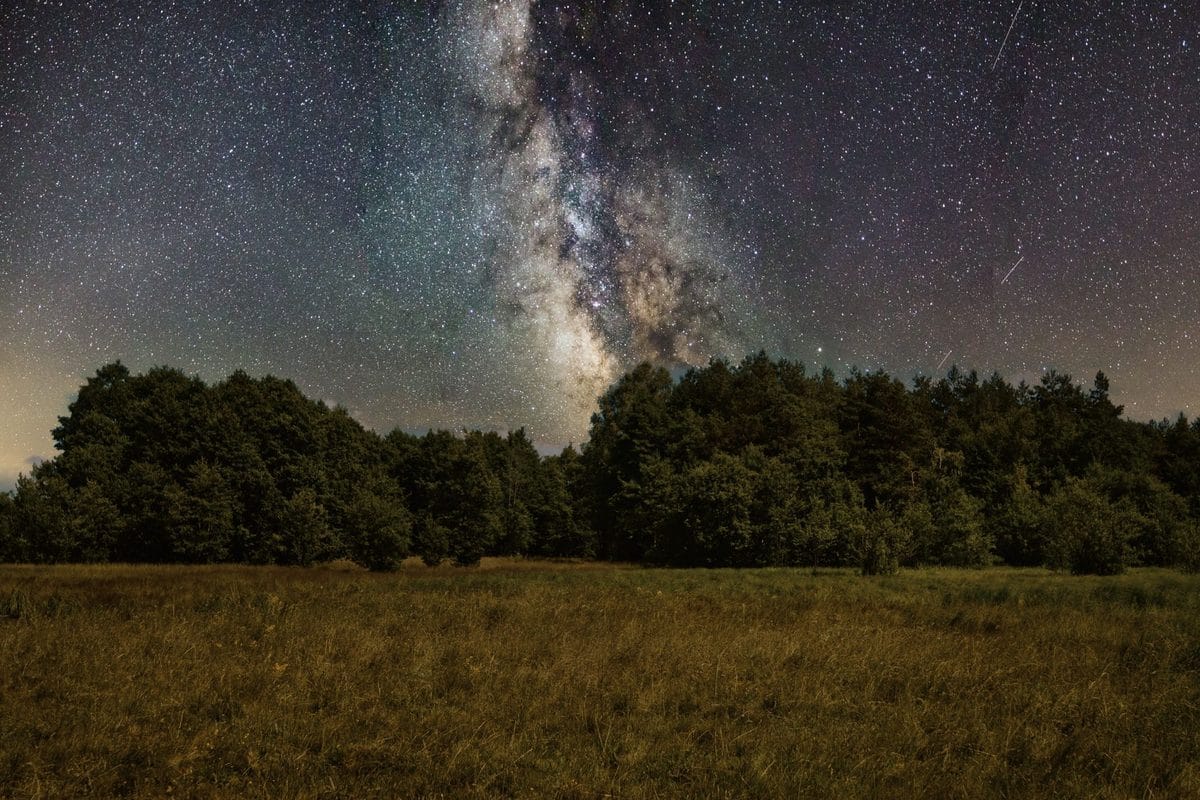
The Moon goes new at 4.50pm on Saturday 10 October. That makes this weekend the first properly dark one of the autumn, and it is why the South of Scotland Dark Sky Festival runs from 9 to 18 October. The clocks do part of the work as well: in Newcastle, full astronomical darkness falls at about 8.20pm on the 10th, and once the clocks go back at 2am on Sunday 25 October it arrives at about 6.45pm. By then the Milky Way, Saturn and a few thousand stars are on show at an hour when children are still awake and the pub is still serving dinner. In midsummer full darkness comes so late this far north that an evening under the stars turns into a midnight one. That is why the people who run Britain's dark sky places treat October to March as their season. Four of those places do it best, Northumberland, Galloway, Exmoor and the Brecon Beacons, and each holds an official International Dark Sky designation. Picking the right night is the real skill, because the school-holiday calendar and the lunar calendar do not agree.
The nights worth circling, and the week to skip
Half-term week is the worst week of October for stargazing.
The Full Moon arrives at 4.11am on Monday 26 October, the first day of half-term for most schools in England and Wales, and a Moon that bright washes out everything except the planets and the brightest stars. Scottish families get the better deal, since most Scottish councils take their autumn break from 12 to 16 October, which sits inside the festival and just after the New Moon. If you are tied to the English dates, spend that week on planetariums and on the Moon itself. Twice Brewed Inn, in Northumberland, has a "Moon Night" session listed for 25 October, which is the right instinct.
| Date | What is happening | What to do about it |
|---|---|---|
| 9 October | Draconid meteors peak, usually with fewer than 10 an hour | Too thin to plan a trip around |
| 10 October | New Moon at 4.50pm | Darkest weekend of the month |
| 16 October to 1 November | Exmoor Dark Skies Festival, 70-plus events | Book now, as many sell out |
| 21 and 22 October | Orionid meteors peak; Moon about 79 and 87 per cent lit | Go after moonset, not before |
| 25 October | Clocks go back at 2am | Full darkness by about 6.45pm |
| 26 October | Full Moon at 4.11am | Skip it for stars |
| 9 November | New Moon at 7.02am | Aim for Friday 6 to Sunday 8 November |
The Orionids are the meteor shower worth staying up for. They are dust from Halley's Comet, active from 2 October to 7 November, and the Natural History Museum and BBC Weather put the peak at no more than about 20 meteors an hour in ideal conditions. This year is not ideal. In Newcastle the Moon sets at about 1.30am on the 21st and about 2.50am on the 22nd. That leaves roughly four moonless hours before dawn twilight on the night of 20 to 21 October, and roughly three on the night of the peak itself. Brighter meteors survive moonlight, as the BBC points out, but the sensible plan is to sleep early, set an alarm and go out once the Moon has gone. Meteors also fall on the nights either side of the peak, only at lower rates.
What the October sky offers
Saturn reached opposition on 4 October, which puts it opposite the Sun and well placed for the whole night. Look for a lone bright point in the south, just below the Square of Pegasus. Kielder Observatory's October guide notes that the rings are more open than last year, when Saturn sat almost edge-on, so a small telescope now shows them far more clearly. Beyond Saturn, a few other targets need nothing more than dark ground and patience:
- The Andromeda Galaxy, at magnitude 3.4, climbs to its highest point in the south around midnight and shows as a faint smudge to the naked eye from a dark site, easier if you look slightly to one side of it.
- The Square of Pegasus makes a free sky-quality test: from a light-polluted street you may count one or two stars inside it, whereas from a proper dark site the observatory says you can pick out upwards of 30.
- Mars and Jupiter return to the morning sky, with Mars rising after 1am at the start of the month and after midnight once the clocks have changed.
The thick, glowing core of the Milky Way that fills summer photographs is a summer sight, and in October the band is thinner and runs overhead. Forestry and Land Scotland says it is usually easy to see from Galloway, but do not arrive expecting the postcard version.
Northumberland: the one with a booking system
Northumberland National Park and most of Kielder Water & Forest Park became England's first International Dark Sky Park in 2013. The national park describes its skies as the most pristine in England, citing the CPRE's 2016 Night Blight report, and Kielder Observatory calls the area Europe's largest Gold-Tier dark sky park. The catch this autumn is that the observatory's main building is closed for repairs. According to its update of 2 October, sessions are being moved to the historic stone Barn at Kielder Waterside, while those at Twice Brewed Inn, in Hadrian's Wall country, carry on as normal. Every session is ticket-only and nothing is sold on the door. The two-mile access track to the observatory is locked outside session times, so a spontaneous drive up for a look will get you nowhere. Most sessions last up to three hours and go ahead in cloud, with talks, demonstrations and the planetarium filling in for the telescopes, and they are cancelled only when travelling there is unsafe.
Twice Brewed Inn is the better base for most people, because the telescopes, the supper and the rooms are under one roof. October evening sessions there are listed from £34.50 a head, and a stargazing-and-supper package adds a two-course meal, with a £5 surcharge for steak and a table reserved two hours before the session. Sessions get booked up: the evenings from 8 to 11 October were already sold out when the booking page was checked on 8 October. Download your ticket before you leave, because mobile signal is poor around the observing sites. Wear more layers than seems sensible, too, since the observatory itself warns visitors not to underestimate how cold it feels standing outside for hours.
Galloway Forest Park: the one you do yourself
Galloway needs no ticket, no booking and no telescope. It was designated an International Dark Sky Park in 2009 and holds Gold Tier status. At 78,000 hectares it is the UK's largest forest park, and about a fifth of it is set aside as a core under a policy of no permanent lighting. Forestry and Land Scotland says more than 7,000 stars and planets are visible on a clear night. It suggests Clatteringshaws Loch, Stroan Loch and Glentrool as starting points, with an information hub at Kirroughtree. Its tips are worth copying: bring a chair, use a red torch, check the lunar cycle and give your eyes 30 minutes to adjust. Other sources are less demanding, with the BBC suggesting 15 to 20 minutes and the Natural History Museum warning that you may see little for the first 10, but take the longer figure and stay put.
The South of Scotland Dark Sky Festival adds more than 50 events across Dumfries & Galloway and the Scottish Borders between 9 and 18 October, overlapping most Scottish councils' autumn week. Its organisers are candid about the risk, noting that true darkness is as rare as seeing the stars. That is the fair way to read every promise here: no operator can guarantee clear skies, so a forecast check on the afternoon of your trip is part of the plan.
Exmoor and the Brecon Beacons: the southern pair
Exmoor became Europe's first International Dark Sky Reserve in 2011, and its Dark Skies Festival, now in its tenth year, runs from Friday 16 October to Sunday 1 November with more than 70 events. Many are not about stars at all, among them UV rock pooling, bioluminescence walks, e-bike night rides and moonlit pool dips. Because the festival straddles the Full Moon, choose events for what they are. The planetarium sessions in Minehead on Monday 19 October and Lynton on Saturday 31 October do not care about moonlight, and neither does the show at the Regal Theatre in Minehead on 25 October. To go it alone, the national park centres hire out telescopes, and a waymarked Dark Sky Discovery Trail runs through some of the darkest parts of the moor.
Bannau Brycheiniog, as the Brecon Beacons are now officially known, was Wales's first International Dark Sky Reserve and, when it was designated, only the fifth in the world. Visit Wales points stargazers to Usk Reservoir, Crai Reservoir, Llangorse Lake and the National Park Visitor Centre, and the park authority has also suggested Hay Bluff. Usk Reservoir is a recognised Dark Sky Discovery Site, which makes it the easiest place to start.
And the northern lights?
The Met Office says the UK's best chances of aurora typically come around the equinoxes, in March and April and in September and October, so this is the right season to hope. The Sun has passed its peak, since recent observations suggest solar maximum came in 2024 and 2025, but the Met Office is clear that significant space weather can still happen in the declining phase. Fast streams of solar wind from coronal holes can produce aurora too. On 8 September it flagged a chance of sightings across much of Scotland while warning that cloud would restrict visibility, which is the usual story.
AuroraWatch UK, a free service run by scientists at Lancaster University, turns magnetometer readings into four colours. Green means nothing doing. Yellow means aurora may be visible by eye from Scotland, amber means it is likely from Scotland, northern England and Northern Ireland, and red means it is likely from anywhere in the UK. Sign up for its alerts and keep your phone charged, but do not book a hotel on the strength of one. Plan the trip around the New Moon and a dark site with an open northern horizon, and treat any aurora as the bonus.
If this weekend is already spoken for, the next New Moon falls on Monday 9 November, which makes Friday 6 to Sunday 8 November the weekend to book today.