Why November suits Glasgow better than you expect
Glasgow has a reputation for weather, and in November it earns some of it. The days are short, the sky is usually grey, and the rain comes in sideways off the Clyde more often than anyone would like. Even so, this is one of the best months to visit. The summer crowds have gone, hotel rates ease after the first week of the month, and the indoor life Glasgow has always been good at becomes the main event rather than a fallback. If you can put up with a waterproof jacket, you get a city that feels like it belongs to the people who live in it.
The clocks go back on Sunday 25 October 2026, so by the time you arrive in early November, sunset falls around half past four in the afternoon. That changes how you plan the day. Museums and galleries work best in the morning and early afternoon, while the evenings suit a long dinner, a pub with a fire, or a theatre seat. Save the walks along the river for the middle of the day, when the light is at its best, and pack a spare pair of dry socks.
Start at Kelvingrove and give it the whole morning
Kelvingrove Art Gallery and Museum sits in Kelvingrove Park in the West End, and it is the obvious first stop. Entry is free, as it is at the other city museums run by Glasgow Life. The building is a red sandstone Victorian palace with a striking central tower, and the collection runs from Dutch and Italian paintings to natural history and armour. Salvador Dalí's Christ of St John of the Cross hangs there and draws a steady crowd, so go to it early, before the school groups arrive. Weekday mornings are noticeably quieter than weekends. Give the Scottish galleries a second visit if you can, because the light changes through the afternoon.
The Spitfire suspended in the central hall is the photograph everybody takes, and it is worth a minute. The better rooms are upstairs, where the Scottish and European painting galleries are quieter than the ground floor. Plan at least two hours if you want to see more than the highlights. Check the opening hours on the Glasgow Life website before you go, because the winter timetable differs from summer and some public holidays change the days.
The Riverside Museum and a walk along the Clyde
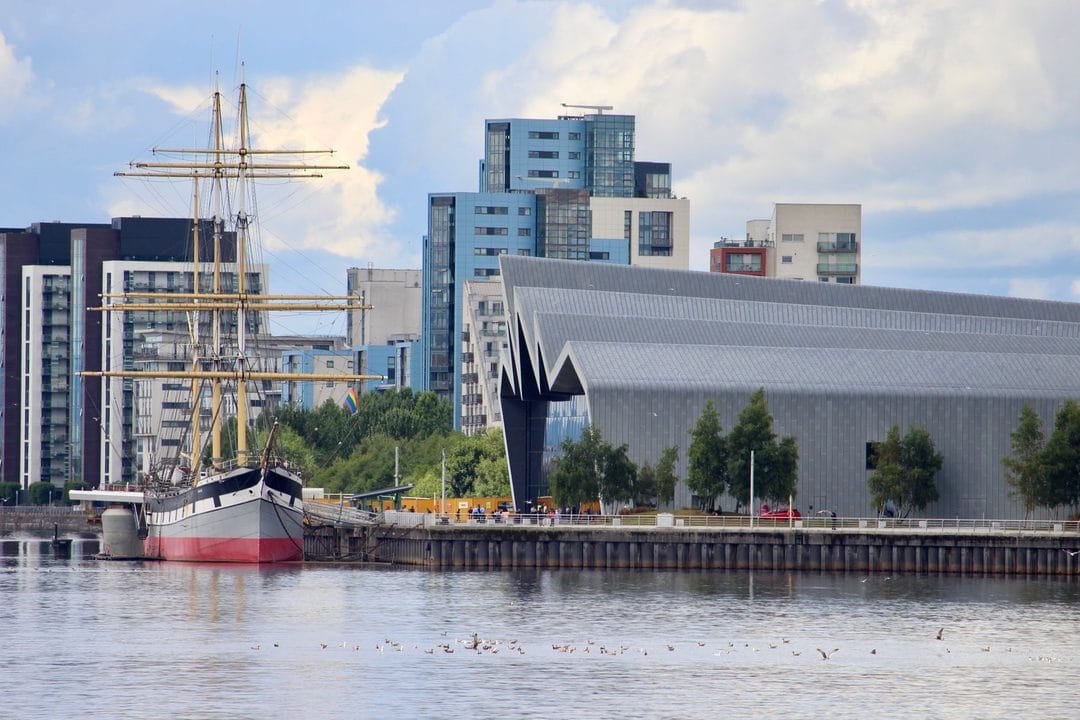
The Riverside Museum, designed by Zaha Hadid and opened in 2011, is the city's transport and technology museum. It is on the north bank of the Clyde, a short walk from the Glenlee, a Clyde-built sailing ship moored outside. Inside you will find a long run of vehicles, from Victorian trams to motorbikes, plus a reconstruction of a Glasgow street that children tend to like more than adults expect. Admission is free, and the building is light and spacious, which matters on a grey afternoon.
From the museum you can follow the river path east towards the city centre. The walk is flat, and on a clear day the cranes and the old shipyard sites give a useful sense of what Glasgow once built. On a wet day, take a bus instead. The point of this route is the river, not the distance, so do not expect a scenic promenade in the style of the Thames. It is a working waterfront with some newer apartments and a few good places to stop for a hot drink.
The Subway: small, old and worth a loop
The Glasgow Subway has 15 stations on a single circular route, and it opened on 14 December 1896, which makes it one of the oldest underground railways in the world. The trains run in both directions on two sets of rails, one clockwise and one anticlockwise, so passengers talk about the Inner Circle and the Outer Circle. The system is small enough that you will learn the stations quickly, and the ride is a cheap way to see the city from the window without changing trains.
The nickname "Clockwork Orange" is often linked to the Kubrick film, but where the name came from is disputed. Some accounts credit a British Rail chairman quoted in a publicity video of the period. Ask a local which version they believe, and you will get a longer answer than you expected. Tickets are sold by SPT, the public transport body that runs the Subway, and the current fares and ticket types are listed on its website. Check them before you travel, because the options have changed over the years.
The Hunterian and the Burrell Collection
The Hunterian, on the university campus on Gilmorehill, is one of the city's oldest public museums and holds a collection that started with the physician William Hunter. It has coins, natural history, and a strong set of Whistler paintings. Its opening hours change between seasons and it is closed on some days of the week, so look at the university website before you plan the day around it. Some parts of the building carry a small admission charge, and the free galleries are the main draw for most visitors.
The Burrell Collection sits in Pollok Country Park on the south side of the city. It was built to house the shipping magnate Sir William Burrell's gift to the city, and it reopened after a long refurbishment. Reaching it takes a little more effort than the West End museums. The usual route is a train to Pollokshaws West, followed by a walk through the park, so allow more time than the map suggests and wear proper shoes. The medieval and Asian rooms are the strongest, and the stained glass is worth looking at on a dull day.
Stops worth a detour between the museums
The Glasgow Necropolis, a Victorian cemetery on a hill east of the cathedral, is free to walk around and is one of the most atmospheric places in the city in November. The paths wind between monuments to merchants, engineers and their families, and the view over the rooftops is better than the walk up suggests. It is quiet on weekdays. Wear shoes with grip, because the paths are steep in places and the ground stays damp for days after rain.
Glasgow Cathedral sits at the bottom of the hill, and its medieval interior is one of the few buildings in the city that predates the industrial boom by several centuries. Entry is free, although donations are welcome. Combine the cathedral and the Necropolis in a single morning, then walk back towards the centre through the Merchant City, where the old warehouses have been converted into shops, bars and a few independent galleries. It makes a useful loop if the weather turns and you need to keep moving.
Eating and drinking in the dark months
The West End is the place to eat. Byres Road is lined with cafés, bars and bookshops, and the streets around it fill up in the evening with students and locals. Ashton Lane, a cobbled lane off Byres Road, has been a pub and restaurant street for decades, and The Ubiquitous Chip, which has been there since the 1970s, is still a reliable place for a long dinner. Ask for a table upstairs if you can, because the room has a warmer feel than the ground floor. Many places fill up after six, so book a table if you have a set time in mind. Walk the length of Byres Road once before you choose, because the menus change from one block to the next.
For a lunch with history, try the Willow Tea Rooms on Sauchiehall Street, which keeps the interiors Charles Rennie Mackintosh designed for the original business. Book ahead at busy times, because the room is small. For a pub with food, Òran Mór on Byres Road is a converted church with a painted ceiling by Alasdair Gray, and it runs a theatre upstairs. Check the listings for the evening shows, since they change through the autumn.
Getting there and what to pack
From London, the train is the sensible choice. Services run from Euston to Glasgow Central, and the journey takes several hours, so take a morning departure and you will arrive in time for a full afternoon. Glasgow Queen Street, the other main station, is closer to the city centre's northern side. Trains are often busy on Friday evenings and on football weekends, so book seats in advance if you travel then.
Pack for wind and rain rather than cold. A good waterproof jacket matters more than a heavy coat, because the city's buildings are warm inside and you will be moving in and out of them all day. Bring a small umbrella that will survive a gust off the river, and shoes with grip for the wet pavements. A thermos is useful for the walks, and a reusable bag helps if you plan to buy books or prints from the shops on Byres Road.
How to split two or three days
Two days is enough for the main sights. Spend the first day in the West End: Kelvingrove in the morning, the Hunterian in the early afternoon, and Byres Road and Ashton Lane in the evening. Spend the second day on the river and the transport side of the city: the Riverside Museum and the Glenlee in the morning, a ride on the Subway in the afternoon, and dinner somewhere near the centre. The Burrell fits either day, but it takes most of an afternoon, so pick one day and leave the rest of it empty.
A third day gives you time to slow down. Use it for a longer walk, a theatre night, or a day trip to somewhere outside the city if the weather allows. The main thing is to avoid trying to do everything in one afternoon. Glasgow rewards people who stop, eat well and let the rain pass, and November is the month when that approach suits the city best.