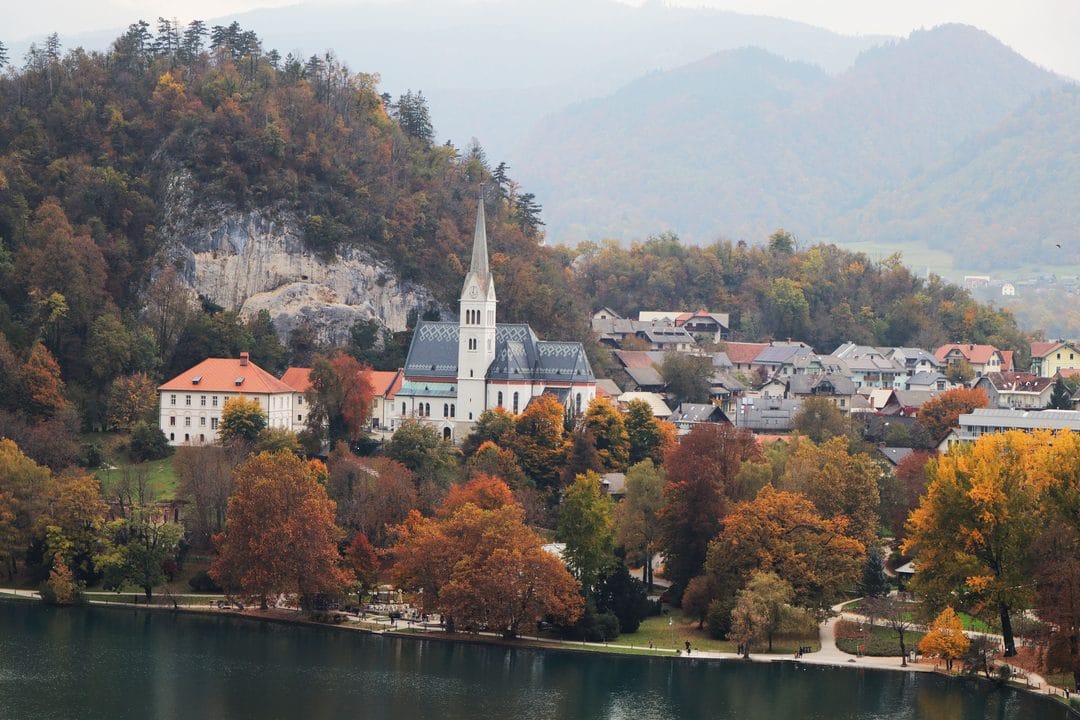
By the second week of September, Lake Bled's promenade empties out enough that you can hear the church bell on Bled Island across the water without a coach party talking over it. The gondoliers who spent July rowing pletna boats back to back are standing around with time to chat. Slovenia's short, sharp tourist season peaks hard in July and August and then falls off a cliff — which is exactly the window UK travellers keep missing, because the school-holiday habit says summer is the only time to go.
Why the shoulder season actually suits the Julian Alps better
Slovenia in August is not a comfortable place to hike. Triglav National Park sits at a latitude and altitude combination that turns August afternoons muggy and thundery, and the popular routes — Vintgar Gorge, the trail up to Mount Vogel above Bohinj, the walk to the Seven Lakes Valley — get busy enough that the narrow gorge boardwalks form queues. September changes the physics of the trip. Daytime temperatures in the valleys settle into the high teens to low twenties Celsius, overnight lows drop enough to clear the humidity, and the thunderstorm risk that makes July afternoons unpredictable largely disappears by the second half of the month. Ljubljana itself, at 295 metres, is still pleasant for café terraces well into October. Pack a proper waterproof shell anyway — mountain weather here can turn in an hour even on a forecast that promised sun all day, and nobody who's been caught above the treeline in a September squall skips that layer twice. If you're planning anything above 1,500 metres, check the trail conditions the morning you set off rather than trusting a forecast made three days earlier.
The catch, and it's a real one: mountain infrastructure starts closing on its own calendar, not the tourist one. Most of the higher planinske koče (mountain huts) in the Julian Alps — the ones on the Seven Lakes Valley circuit or near Triglav's summit routes — shut for the season around 20-30 September, depending on the weather that particular year, and a handful close even earlier if the first snow arrives on schedule. If a multi-day hut-to-hut route is the plan, the first half of September is the safer bet. If it's day hikes from Bled or Bohinj with a bed in a valley hotel each night, the whole month works, and even the first week of October is often still fine at lower altitudes.
Lake Bled and Bohinj, minus the queue for the boat
The queue for the pletna boat is the best proxy going for how differently this lake behaves once September arrives.
Bled in peak season means a 20-30 minute wait for that boat out to the island, and the swimming platforms near the castle side packed by 10am. By mid-September, the boats leave with space to spare, the lake's water temperature is still swimmable for anyone not precious about it — typically 18-20°C early in the month — and the castle above the lake, which charges around €18 for the museum and viewpoint, no longer needs a timed slot. Bohinj, twenty minutes further into the mountains and always quieter than Bled even at peak, gets genuinely still. The Vogel cable car keeps running into autumn and gives a proper alpine panorama for a fraction of the effort of hiking it, and the walk around Bohinj's lakeshore to the Savica waterfall trailhead is one of the better half-day outings in the country.
Skip the Bled Castle restaurant terrace for lunch — it's priced for the view, not the food, and there are better options two minutes' walk into town. The kremšnita, Bled's famous custard cream cake, is worth the calories at Šmon or the original Park Hotel café; everywhere else selling it is trading on the name.
The grape harvest gives the trip a second reason to go
September in the Vipava Valley and Goriška Brda, Slovenia's two main wine regions near the Italian border, means trgatev — the grape harvest — is either underway or about to start, depending on the variety and the year. Goriška Brda, sometimes called Slovenia's Tuscany for its rolling hills of vineyards and cherry orchards, runs harvest festivals through September where small family wineries open their cellars for tastings that cost a fraction of what the same experience runs in Tuscany or the Douro. A flight of five wines with a plate of local prosciutto and cheese at a Brda vineyard typically comes to €15-25 per person — Rebula, the region's signature white grape, is the one to try, and it doesn't travel well in reputation the way it does in the glass, so drinking it here is the point. Vipava Valley, closer to Ljubljana, does the same thing on a slightly larger scale with its wine roads open to casual drop-ins, no booking required at most smaller producers.
Getting there from the UK, and what it actually costs
Ljubljana Jože Pučnik Airport is the arrival point, and it's a small, easy airport 25km north of the city with a straightforward bus or transfer into town. EasyJet flies the route from London Gatwick, and Wizz Air runs it from London Luton; flight time is a little over two hours, and September fares tend to sit noticeably below August's, since the route isn't propped up by the same package-holiday demand that keeps Mediterranean routes expensive right through the school summer. Ryanair also serves nearby Trieste and Venice, both within a manageable transfer of Bled and the Julian Alps if the Ljubljana fares don't line up with the travel dates.
Accommodation is where September earns its keep. A double room at a mid-range Bled guesthouse that runs €140-160 a night in August commonly drops to €95-115 by mid-September, and Bohinj — always the cheaper of the two lakes — goes lower still. Ljubljana's old town hotels follow the same pattern, dropping roughly 20-25% once the July-August surcharge lifts. Car hire is worth arranging for anyone planning to reach Vipava or Brda independently, since public transport into the wine regions is thin; a small manual hatchback for a week typically runs €180-250 booked in advance, more if left to the airport desk on arrival. Add up a week of that — cheaper room, cheaper car, no summer surcharge on the wine tastings — and the saving over an equivalent August trip is easily €200-300 for two people, before flights are even factored in. Even the flights themselves tend to undercut August, since easyJet and Wizz Air both price the route against school-holiday demand that drops off sharply after the first week of September.
None of this makes Slovenia a secret exactly — Bled has been on every "hidden gem" listicle for a decade, which is precisely the kind of claim that stops being true the moment enough people read it. What's still genuinely true is the calendar mismatch: most of Bled's visitors come in July and August because that's when they can travel, not because that's when the country is at its best.
A realistic four days, and one detour worth the extra petrol
Two nights in Bled covers the lake, the castle, the boat crossing and a day hike into the mountains above Bohinj. A third night in Bohinj itself puts the Vogel cable car and the Savica waterfall trail within easy reach without the twenty-minute drive each way. The fourth day is where most itineraries go wrong: people drive straight back to Ljubljana for the flight home and skip the wine regions entirely, when Vipava is barely forty-five minutes off the direct route to the airport. Build in a two-hour stop at a Vipava producer on the drive back and the trip gains its best afternoon for almost no extra time.
- Bled: two nights, lake walk, castle, one day hike toward Vintgar Gorge
- Bohinj: one night, Vogel cable car, Savica waterfall trail
- Vipava Valley: a half-day stop on the way back to Ljubljana airport, wine tasting at a family producer
- Ljubljana itself, if there's a spare afternoon before the flight — small enough that you can see the old town and the Ljubljanica riverside cafés on foot in three hours
Anyone tempted to stretch the loop further west should know that Piran, Slovenia's one proper stretch of Adriatic coast, is under two hours from Bled and still holds late-summer warmth well into September — a Venetian-looking old town on a tiny peninsula, with none of the crowd pressure of Croatia's coast an hour further south. It's a genuine option for a fifth day, though it pulls the itinerary away from the mountains and toward a beach-town pace that doesn't always suit a hiking-focused trip.
Slovenia is small enough that none of this is a stretch
The country's whole appeal for a September trip is compactness. Bled to Bohinj is a twenty-minute drive. Bohinj to the Vipava wine road is under two hours. Ljubljana airport sits roughly equidistant from all of it, which means you can land, collect a hire car, and be swimming in Lake Bohinj inside ninety minutes — something that simply isn't true of the Greek islands, the Douro, or Sardinia, where a ferry or a long coastal drive eats half the first day. Slovenia uses the euro and sits inside the Schengen area, so a day trip across the Italian border near Trieste or down into Croatia's Istria peninsula involves no passport stop at all, just a change in road signage.
Book the flights for the second half of September rather than the first if hut closures aren't a concern — the crowds thin further, the harvest festivals in Brda tend to cluster around the third weekend, and hotel rates keep falling right up until the October half-term bump. Anyone chasing summer swimming weather should still go in August; anyone who wants the mountains, the lake and the vineyards without fighting for a parking space should book September and not look back.