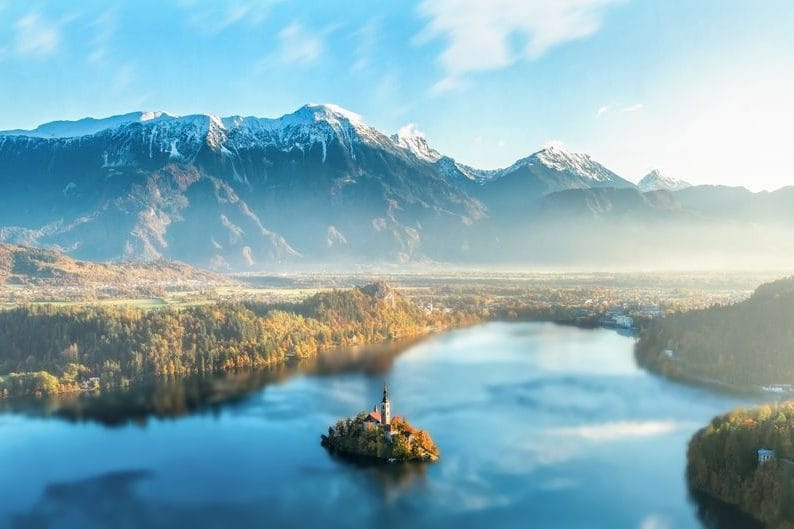
For a country you can drive across in three hours, Slovenia packs in an absurd amount: a turquoise alpine lake with an island church, a capital that bans cars from its old town, and a river so green it looks colour-graded. Late June is the sweet spot — the snowmelt has settled, the Adriatic is warm enough for a swim, and the August crush of Italian and Austrian holidaymakers hasn't arrived yet. And you can do the whole thing on trains and buses, which is just as well, because parking at Lake Bled in summer is its own special misery.
Getting there from the UK is the one bit that takes planning. There's no direct flight to Ljubljana from most British airports beyond a seasonal Wizz Air route, so the common approach is to fly into Venice Marco Polo or Treviso — easyJet and Ryanair both run them from around £40–£70 return in late June if you book a few weeks out — and then take the GoOpti shared shuttle from Venice straight to Ljubljana or Bled for roughly €30–€40. It's a three-hour run that most people sleep through. Trieste is the other gateway, closer to the Slovenian border, with a regular bus onward to Ljubljana.
Ljubljana: the warm-up that turns into the highlight
Most people treat Ljubljana as a stopover and then wish they'd given it two nights. The old town is pedestrianised, the Ljubljanica river is lined with cafés, and the whole place has the relaxed feel of a university city that never quite filled up with tourists. Climb to the castle for the view — the funicular is about €4 each way, or walk it in twenty minutes if your knees allow. Plečnik's bridges and the covered market are free and genuinely worth an hour.
A few practical anchors. A flat white or a local craft beer runs €3–€4, well below Venice prices an hour west. The Saturday open-air market along the river is the place to assemble a picnic of Karst prosciutto and Tolminc cheese. And the city is small enough that you'll never need a taxi — most of what you want is within a fifteen-minute walk of Prešeren Square.
Where to stay without overpaying
Hostel Celica, a converted military prison where each cell was redesigned by a different artist, is the cult choice and books out fast for late June — expect £30–£45 for a private room. Mid-range hotels near the centre sit around £80–£110 a night in season. If those are gone, the suburb of Bežigrad is a ten-minute bus ride and noticeably cheaper.
Lake Bled: beautiful, busy, and best early
Bled is the postcard, and the postcard is real. Trains from Ljubljana run to Lesce-Bled station in about 40 minutes for under €7, then it's a short local bus or a twenty-minute walk down to the lake. The classic thing is to row a pletna boat out to the island church — about €18 a head for the return trip — or rent your own rowing boat for roughly €20 an hour and do it yourself, which I'd recommend if there are two or three of you.
Here's the honest bit: by eleven in the morning in summer, the lakeside path is shoulder to shoulder. Go at eight and you'll have the mist coming off the water and the boats still tied up. The walk around the lake is about six kilometres and almost entirely flat. For the famous viewpoint from above, the hike up to Ojstrica or Mala Osojnica takes 30–40 minutes and rewards you with the shot everyone's seen on Instagram, minus the crowd.
- Try a slice of kremšnita, the custard-and-cream cake invented at the lakeside Park Hotel — about €5 and worth queuing for.
- Skip the overpriced lakefront restaurants and walk five minutes inland for half the price.
- If Bled feels too busy, nearby Lake Bohinj is larger, wilder and quieter — an easy bus ride on and inside Triglav National Park.
The Soča Valley: the part most people miss
If you only have time for one more stop, make it the Soča. The river runs an unreal milky emerald through a steep alpine valley near the towns of Bovec and Kobarid, and it's the reason serious walkers and rafters come to Slovenia at all. Getting here car-free is the trickiest leg — there's a seasonal bus over the Vršič pass from Kranjska Gora, a switchback road that is a spectacle in its own right, or buses up from the coast via Nova Gorica. Check the Arriva and Nomago timetables before you commit, because services thin out fast outside July and August.
Once you're there, Bovec is the base for white-water rafting (around €45–€55 for a half-day with a guide), and Kobarid has a quieter charm plus a genuinely moving WWI museum about the Isonzo Front. The Kozjak waterfall walk from Kobarid is an easy 90-minute round trip and one of the prettiest short hikes in the country.
A rough budget for a week
None of this is Switzerland-expensive, which is the pleasant surprise. Reckon on £40–£70 for flights, a few euros a day on regional trains and buses, accommodation from £30 a night in hostels to £110 in a decent hotel, and meals at €10–€18 for something substantial. A careful week — Ljubljana, Bled and the Soča — comes in well under £600 a head including the flight, and that's with rafting and a few sit-down dinners thrown in.
The catch, if there is one, is the buses. Slovenia's rail network is good between the main towns but thin in the mountains, so the Soča Valley in particular rewards anyone who'll plan a day ahead and accept the odd long wait at a village stop. Bring a paper backup of the timetable. Mobile signal in the valleys is patchy, and the bus that exists on the website doesn't always exist on a wet Tuesday in late June.