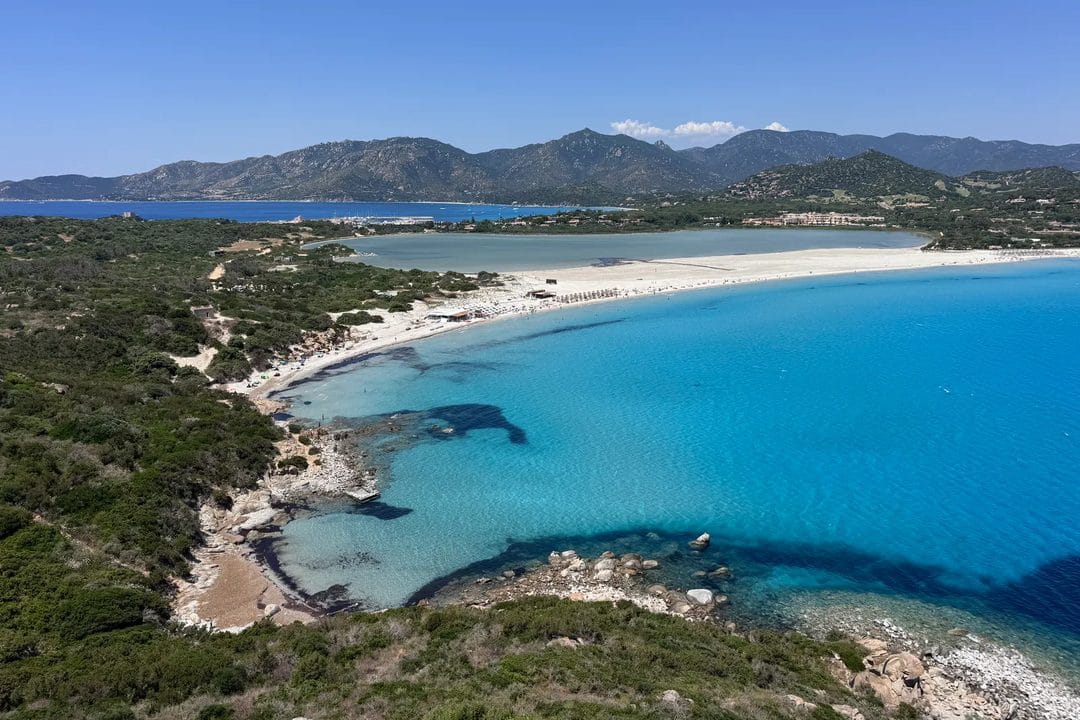
There is a specific date on which Sardinia changes character, and it isn't the first of September. It's the fifteenth of August — Ferragosto, the Italian public holiday that empties the mainland and fills every beach on the island for one final, chaotic week. The day after, something odd happens: sunbeds start disappearing from restaurant terraces, half-board rates on booking sites drop by a third overnight, and the queue for the car ferry at Olbia's port shrinks from hours to minutes. September is what's left once that exodus finishes, and for anyone who isn't tied to school holidays, it's the better month to book by a wide margin.
Why September beats the obvious choice
August in Sardinia is expensive because Italians make it expensive, not because the island itself changes. Domestic tourism dominates the Costa Smeralda and the northern coast from mid-July through Ferragosto, and prices track that demand almost exactly — a beachfront double room that runs €180 a night in early September can easily hit €320 in the first week of August. Once the holiday passes, the sea hasn't cooled down (it typically sits around 24–25°C through most of September, only a couple of degrees off its August peak) and daytime air temperatures still climb into the mid-to-high twenties. What's gone is the crowd, and with it, a good chunk of the markup.
This isn't a secret only to locals. Travel forecasters and airlines have caught on, which is exactly why September fares from the UK sit well below August's: a one-way easyJet ticket from Bristol or Gatwick to Olbia can run £40–£70 in September against £120 or more at the height of summer, and Ryanair's routes into Cagliari and Alghero follow a similar pattern. Book six to eight weeks out rather than at the last minute — shoulder-season fares are cheap but not bottomless, and the good ones on Friday evening departures go first.
Getting there and getting around
Sardinia has three airports worth knowing: Olbia Costa Smeralda in the north-east, Cagliari Elmas in the south, and Alghero-Fertilia in the north-west. Which one you fly into should be decided by where you're actually staying, not by whichever has the cheapest headline fare, because the island is larger than it looks on a map and cross-country drives eat into a short trip fast. Olbia to Cagliari, for instance, is a good two-and-a-half to three hours by car along the SS131 — doable for a one-way transfer, miserable as a day trip.
- Olbia Costa Smeralda — best for the north-east coast, San Teodoro and the Maddalena archipelago crossings
- Cagliari Elmas — best for the south, Chia, Villasimius and day trips into the interior including Barumini
- Alghero-Fertilea — best for the north-west coast and the Costa Verde beyond it
A hire car is not optional here. Public transport exists — the regional ARST bus network reaches most towns — but timetables thin out considerably once you're off the main coastal routes, and the beaches worth the detour are, almost by definition, the ones without a direct bus. Expect to pay roughly £35–£50 a day for a small hire car booked in advance during September; leave it to the airport counter on arrival and that figure climbs quickly.
Costa Smeralda versus the coast nobody markets
The Costa Smeralda earned its reputation honestly — the water off Porto Cervo really is that shade of turquoise, and the granite headlands really do look sculpted rather than eroded. But it was built from the 1960s onward specifically to be exclusive, and in September that history still shows up in the bill: a simple lunch near the marina can run €35–45 a head before wine. Book here if you want the postcard version of Sardinia and don't mind paying for the branding attached to it.
The better value, and frankly the better beach experience, sits an hour or two further south or west. Chia, on the southern coast near Cagliari, has dune systems and a lagoon backdrop that rival anything on the Costa Smeralda at roughly half the price. The Costa Verde, further north-west past Oristano, goes further still — the dunes at Piscinas rise over 100 metres in places, there is essentially no beachfront development, and in September you can walk a kilometre of sand without passing more than a handful of other people. It isn't glamorous. There's no beach bar, no sunbed rental, and the nearest proper restaurant is a drive away — which is precisely the trade-off worth making if quiet is the point of the trip.
The Maddalena archipelago
Off the north-east tip of the island, reachable by a short ferry or a full-day boat excursion from Palau or Olbia, the seven main islands of the Maddalena archipelago sit inside a marine protected area with some of the clearest water in the western Mediterranean. Budelli's famous Pink Beach has been closed to landing since the early 1990s to protect the coral fragments that give the sand its colour — boats can circle it, but you won't be setting foot on it, whatever an old guidebook might promise. Spargi and Santa Maria are the better bets for actually swimming, with coves accessible only by boat and a sea colour that looks retouched even in an unedited phone photo.
A half-day group boat trip from Palau runs somewhere in the €35–50 range per person in September; a private charter for a small group costs considerably more but buys the freedom to linger at whichever cove is emptiest that day, which in high summer would be none of them.
Su Nuraxi and the case for a day inland
Most first-time visitors never leave the coast, which is a mistake September specifically corrects for — the interior, brutal under the July sun, becomes genuinely pleasant to explore once the heat breaks slightly. Su Nuraxi di Barumini, roughly an hour north of Cagliari, is the best-preserved of Sardinia's nuraghi: Bronze Age stone towers unique to the island, this one a UNESCO World Heritage Site since 1997 and easily the most complete complex open to visitors. Entry runs around €10–12 with a guided tour included, and the guides — mostly archaeology graduates from the local area — are considerably better informed than the plaque-reading experience you get at most ancient sites.
Pair it with lunch in Barumini itself rather than rushing back to the coast. The inland towns of the Marmilla region serve some of the island's more honest cooking — culurgiones (a ravioli-like pasta stuffed with potato, pecorino and mint) and porceddu, slow-roasted suckling pig, show up on menus here at prices a third lower than anything near a beach resort.
Where to actually base yourself
For a first visit of five to seven days, San Teodoro is the strongest all-round base. It sits close enough to Olbia airport for an easy transfer, has its own excellent beaches (La Cinta is a genuine highlight, not a consolation prize), and puts the Maddalena boat departures at Palau within forty minutes by car. Avoid Porto Cervo itself unless the Costa Smeralda experience is specifically what you're after — it's beautiful for an afternoon and expensive for a week.
If the trip leans more toward hiking and quiet coastline than boat trips and archipelagos, base in or near Cagliari instead. The city has its own charm that gets overlooked in favour of the coast — a genuinely walkable old town, a decent late-summer restaurant scene, and an airport fifteen minutes from the centre — and it puts Chia, Villasimius and Barumini all within a manageable drive.
What it actually costs
A realistic September budget for two people, mid-range rather than luxury, looks something like this: £80–140 return flights per person from a UK regional airport, £35–50 a day for a hire car, €100–180 a night for a comfortable double away from the Costa Smeralda's premium strip, and €50–70 a day for food if you mix trattoria lunches with one proper dinner. Add the Maddalena boat trip and Barumini's entry fee and a week for two comes in somewhere around £1,400–1,800 all-in, considerably below what the same itinerary would cost in the first two weeks of August.
A few things worth knowing before booking
- September is technically still hurricane-adjacent weather territory for the western Mediterranean — the odd sharp thunderstorm does roll through, usually in the last week of the month, so don't schedule the only rainless day of the trip around a boat excursion
- Many family-run restaurants and some smaller hotels close for their own holiday in the first half of September, right after the domestic season ends — check opening dates directly rather than trusting an aggregator listing
- Water sports operators (diving, kayaking) tend to run reduced hours from mid-September, and some wind down entirely by the last week
- Sunscreen and lightweight layers both belong in the case — midday sun is still strong, but evenings on the coast cool noticeably once the sun drops, more than most visitors expect from a Mediterranean island this far south
None of this makes September a compromise. It makes it the version of Sardinia that the marketing photos were taken during — before the crowds arrived, not after they've been edited out.