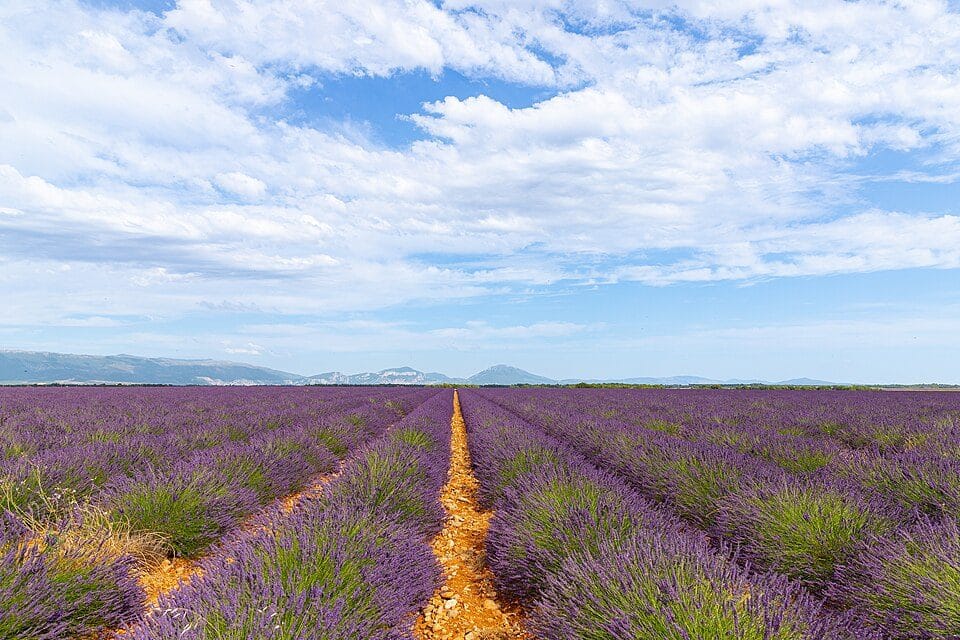
The photograph never shows what's just out of frame. Stand in the middle of the Valensole plateau in the second week of July, phone raised at the same angle as everyone else, and behind you there's a gravel overflow car park with three coaches idling, a family arguing about whose turn it is to hold the toddler, and a van selling lavender ice cream at a queue twelve deep. The purple rows are real. So is the crowd standing in them. If you're planning a lavender trip to Provence this summer, the difference between a good week and a miserable one comes down to timing, geography and a willingness to drive past the famous field for the sake of a quieter one.
The bloom window is shorter than the postcards suggest
Lavender doesn't flower on a fixed date, and every year the window shifts by a week or two depending on the spring rainfall and how hot June turned out to be. As a rule, the lower plateau around Valensole (roughly 500–600 metres) comes into full colour first, usually from the last days of June through to around 20 July. Head higher, onto the Sault plateau or towards Ferrassières at 800–1,000 metres, and the same fields can still be blooming into the first week of August, sometimes later in a cool year. That gap matters: if you're travelling in the third week of July and Valensole has already gone patchy or been cut, the higher ground is your fallback, not an afterthought.
Growers cut for distillation as soon as the oil content peaks, which in a hot year can mean a field you saw glowing purple on Monday is stubble by the following weekend. Nobody times a harvest around tourists, and rightly so — this is a working agricultural crop, not a photo set built for Instagram, and the growers who let visitors wander the edges of their fields are doing you a favour, not running an attraction.
Valensole is the postcard — and the problem
Valensole earned its reputation honestly: the plateau is enormous, the fields run in long uninterrupted stripes against the Alpine foothills, and on a clear morning the light does genuinely look unreal. It's also the single most photographed patch of farmland in France, which by July means coach tours from Aix, Marseille and Nice arriving on a rolling schedule from around 9am, peaking again in the late afternoon when the light turns gold. Between roughly 11am and 4pm the heat is punishing anyway — Provence in July regularly hits 32–35°C — so the crowd and the worst of the sun overlap almost exactly.
Go at dawn instead. The D8 and D6 roads out of Valensole village towards Puimoisson are lined with working fields, and by 7am you'll share them with perhaps a dozen other early risers rather than several hundred. Bring your own breakfast; nothing in the village opens before 8. It's a genuinely early start, and it's worth setting the alarm for — the alternative is fighting for a verge to park on at midday in 34-degree heat, which nobody enjoys, however good the photo turns out.
The routes that skip Valensole altogether
Skip Valensole in July and you haven't missed the lavender — you've traded the famous version for a better one. The Sault plateau, roughly an hour north of Valensole via the D950, is where most French visitors actually go, and it shows in how much less built-up the tourist infrastructure is: fewer signposted "lavender routes," fewer souvenir stands, more actual farms getting on with actual farming.
- Sault itself has a modest lavender festival in mid-August (after harvest, so plan the fields separately from the festival) and a genuinely good Wednesday market worth timing a visit around.
- Ferrassières and the plateau d'Albion, further east, sit high enough that the flowering runs later — useful if you're travelling after 20 July and Valensole has already been cut.
- Simiane-la-Rotonde, a stone hilltop village with a round medieval keep, has small fields on its outskirts and none of the coach traffic — you'll likely be the only visitor there before 10am.
- Banon, better known for its goat's cheese wrapped in chestnut leaves, has lavender growing right up to the edge of the village on the road towards Saumane.
None of these will hand you the exact wide-shot symmetry of Valensole's biggest fields. What you get instead is lavender you can actually walk beside without a marshal waving you off private land, and villages that don't shut down into pure tourist infrastructure for eight weeks a year.
Distilleries are worth more of your time than the fields
Most visitors spend twenty minutes at a field and skip the distilleries entirely, which is the wrong way round. The Musée de la Lavande in Coustellet, near Gordes, runs proper tours explaining the difference between true lavender (Lavandula angustifolia), the hardier lavandin hybrid grown for soap and detergent, and why the essential oil price varies by a factor of four between them — true lavender oil sells for roughly €80–100 per litre wholesale, against €20–25 for lavandin. That distinction is invisible from a photograph and genuinely interesting once someone explains it.
Smaller family distilleries around Sault and the Ferrassières road will often let you watch a batch go through the still if you turn up at the right moment — there's no schedule for this, it happens when the day's cut lavender is ready, so ask rather than assume. A fifteen-minute conversation with someone who's grown the crop for thirty years will teach you more than any placard, and the small bottle of oil you buy afterwards costs less than the tourist-shop version in Aix and is guaranteed to be from that field.
Getting there without turning it into a driving holiday
A car makes the back roads easier, but it isn't strictly necessary, and Provence in July is not a fun place to be stuck in traffic on the D22 behind three coaches. The TGV runs from Paris to Aix-en-Provence TGV station in around three hours, and from London it's a straightforward connection via Paris Gare de Lyon — roughly seven hours door to door if the connection is tight, which beats a full day of flying and airport transfers for anyone starting from the south-east of England.
From Aix, hire a car for the plateau days specifically rather than the whole trip — most agencies at the TGV station will do a two- or three-day rental without penalty, and you can hand it back and take the train onward to Marseille or back to Paris. Cyclists do the Luberon back roads regularly in July, but only early morning or evening; the climbs around Sault in full afternoon sun are genuinely dangerous heat exposure, not just uncomfortable, and local cafés will tell you as much if you ask.
Where to base yourself, and when to actually go outside
Apt or Gordes work well as a base for the Luberon side of things, with good access to Sault and Banon within forty minutes. Manosque sits closer to Valensole itself if the classic plateau is your priority. Whichever you choose, structure the day around the two cool windows — out by 7am, back indoors or in shade by 11, out again after 6pm when the light softens and the coach parties have mostly left for their hotels in Aix or Avignon.
A €25–35 lunch menu in a village like Simiane or Banon will usually beat a €50 one in Gordes, which has priced itself for day-trippers from the coast. Order the tapenade and a glass of local rosé and you'll understand why this region built its reputation on food quite separately from lavender — though it's the lavender that gets it onto everyone's July shortlist in the first place. Book dinner ahead in any village with fewer than a thousand residents; kitchens here close early and don't always take walk-ins once the tables are full, which surprises visitors used to city dining hours.
Beyond the fields
Lavender is the reason to come in July, not the only reason to stay a week. The Gorges du Verdon, an hour east of Valensole, offers proper cold-water swimming when the plateau heat gets too much — the turquoise water stays a shock even in August. Roussillon's ochre cliffs, thirty minutes from Gordes, turn a completely different colour palette entirely and are worth a half-day on their own. And the Luberon's Saturday and Wednesday markets — Apt on Saturday, Sault on Wednesday, Coustellet on Sunday afternoons in summer — are where the actual local economy shows up, stalls of melons, olive oil and fresh goat's cheese well away from anything built for a coach itinerary.
Come for the purple fields if that's what pulled you here — they earn the reputation. Just don't let Valensole at midday be the only Provence you see.