Ask any easyJet or Ryanair gate agent what causes the most scrambling on a July departure board, and lost boarding passes won't make the list — the cabin-bag sizer parked by the gate will. Get caught trying to squeeze a wheelie case through it after checking in online for free, and easyJet's gate fee can run to £54 depending on the route and how close to departure you are; Ryanair's charge for an oversized bag sits in a similar range, and both airlines are notably less forgiving in peak summer weeks when queues stretch back past the coffee kiosk. For a fortnight in Europe, the packing decision that actually matters isn't which jumper to bring — it's whether you're travelling with one bag or two, and that choice gets made weeks before you ever reach the airport.
Why one bag wins over a fortnight, not just a weekend
The one-bag method has a reputation as a short-break trick — fine for two nights in Lisbon, hopeless for fourteen days away. That reputation doesn't hold up once you look at what a longer, multi-leg trip actually costs. Airlines charge for hold luggage per route, per leg, so an itinerary like London to Porto, a budget hop down to Faro, then home again can add £150 or more in bag fees alone if you're checking a case each way. Ryanair applies the same per-leg logic to its own charges, and a family of four repeating that pattern across a summer of connecting flights can end up handing back several hundred pounds in accumulated fees before they even reach the hotel. Travel with everything you need in one 40-litre bag under 10kg, and every one of those legs becomes free, and you never stand at a carousel wondering whether ground handlers in Faro have actually loaded your case onto the right aircraft. You do have to be ruthless about what goes in, and that ruthlessness is the entire skill — pack for the trip you're taking, not the one where you might need an evening dress, a spare pair of boots and a hairdryer "just in case".
The hand-luggage rules that actually matter this summer
Every airline publishes a maximum cabin-bag size, and almost nobody reads it properly until they're standing at the sizer with a queue building behind them.
easyJet's free allowance is a bag no larger than 45 x 36 x 20cm, and it has to fit under the seat in front of you rather than in the overhead locker. Pay for Up Front or Extra Legroom seating and you unlock a second, larger cabin bag — up to 56 x 45 x 25cm — that goes overhead instead, which is the detail most passengers miss when they're deciding whether a soft rucksack will actually do the job. Ryanair runs a near-identical two-tier system: a small personal bag included with every fare, and a 10kg Priority bag (55 x 40 x 20cm) that costs extra unless you've already paid for Priority Boarding, typically £6–£10 more per person booked in advance and considerably more if you leave it until the airport. Neither airline weighs the small personal bag consistently at every gate, which sounds like good news until you remember it means the one time they do check, it's usually because the bag was visibly bulging past its stitching. Wizz Air and Vueling use broadly similar dimensions, though the numbers shift by a centimetre or two between carriers, and that centimetre is exactly what catches people out in July, when gate staff have run out of patience for arguments about soft-sided bags "compressing." Several carriers, Ryanair included, have quietly tightened their gate sizers over the past few years without much announcement, so a bag that sailed through in 2022 isn't guaranteed to fit now, and the only way to be certain is to measure it against the airline's current published dimensions rather than trust memory from a previous trip.
One-bag travel isn't free of trade-offs, and it's worth saying so plainly: if your trip includes a black-tie wedding or a week of proper hillwalking, forcing formalwear or hiking boots into a 20-litre pack is technically possible but genuinely miserable. In that case, checking one bag deliberately beats fighting the system for a fortnight — the method is meant to serve the trip, not the other way round.
What actually fits in a 20-litre bag for two weeks
The maths sounds impossible until you stop packing outfits and start packing a system. A fortnight away doesn't need fourteen different tops — it needs a small number of pieces that combine into more outfits than the piece count suggests, plus a plan for washing things every four or five days rather than carrying enough to avoid it entirely.
The five-outfit formula
- Three short-sleeve tops and one long-sleeve layer, all in colours that mix with everything else you've packed
- Two pairs of trousers or shorts — one you'd wear to a decent restaurant, one you wouldn't mind ruining on a hike
- One dress or smart shirt that does the job of "evening wear" without pretending to be black tie
- Underwear and socks for five days, not fourteen — you will find a launderette, or a sink and some travel detergent sheets, and that's honestly fine
- One pair of trainers worn on the plane, one pair of sandals packed flat, and nothing else, because a third pair of shoes is the single most common reason a 20-litre bag stops zipping
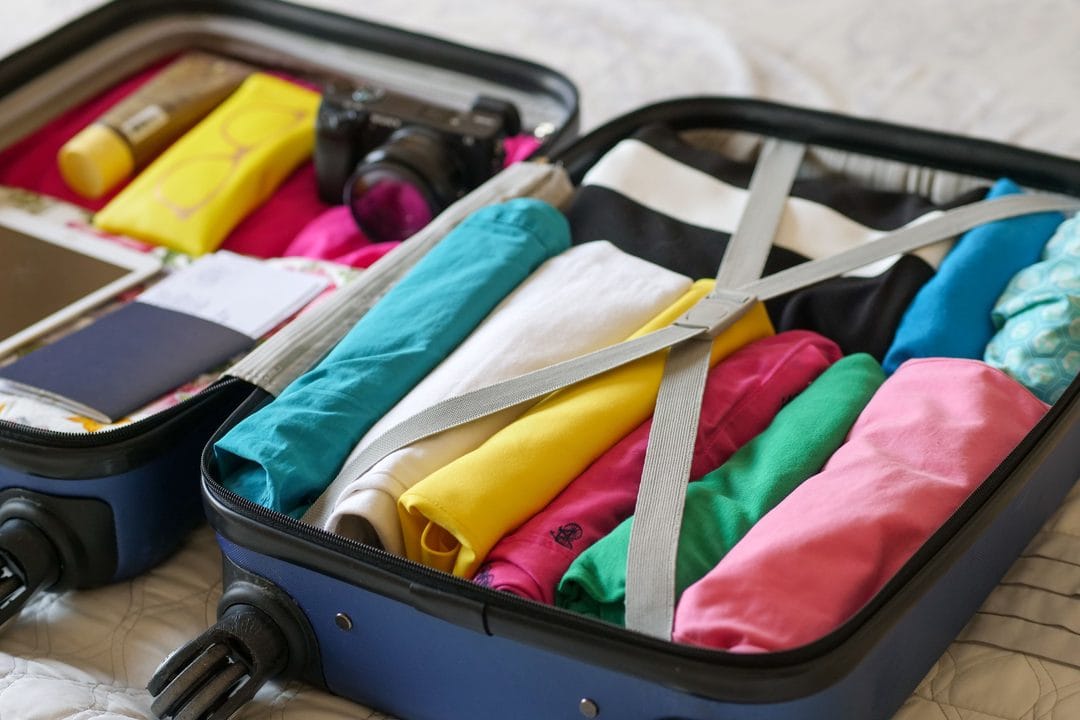
Roll rather than fold, and use two or three packing cubes to separate clean clothes from worn ones — it sounds like a minor habit, but it's the difference between finding a top in four seconds on day nine and upending the whole bag onto a hostel bed.
Toiletries and the liquids limit
UK airport security still enforces the 100ml-per-container rule inside a single resealable bag, and that hasn't changed despite years of promises about new scanners removing the restriction at every airport. Decant shampoo, sun cream and anything else liquid into 100ml bottles before you leave rather than buying travel-sized versions at the airport, where the same product routinely costs two or three times as much. Solid alternatives — shampoo bars, solid deodorant, solid sun cream sticks — sidestep the limit entirely and take up noticeably less room than their bottled equivalents, which matters more than it sounds when you're working with 20 litres total.
The kit that earns its space
Buy the Osprey Fairview 40 or the Decathlon Forclaz Travel 100 over a generic supermarket rucksack — both survive being crammed under an aircraft seat for a fortnight without the zips giving out, and both cost under £90, which is less than most people spend on bag fees in a single round trip. Skip the branded toiletry bottles sold in airport shops entirely; a set of reusable 100ml silicone bottles from Muji or Boots runs about £6 and refills easily from full-size bottles at home. A universal travel adaptor is worth the £12–£15 it costs precisely once, on the first trip you take it on, and then it lives in the bag permanently rather than being repurchased every holiday.
What to leave behind — commit to it
The book you won't finish, the "just in case" cardigan, the second pair of jeans, the hairdryer every hotel and most Airbnbs already provide — these are the items that turn a 20-litre bag into a 30-litre problem, and the discipline is simply refusing to add them back in once you've taken them out. You don't need a paper guidebook when your phone already has offline maps downloaded. And you don't need three "smart casual" outfits for a trip where you'll realistically wear the same two things to dinner on rotation, because nobody you meet on holiday is cataloguing your wardrobe the way you imagine they are.
ABTA, ATOL and what one-bag travel doesn't protect you from
Packing light protects your wallet from airline fees; it does nothing for your money if the trip itself falls apart. Book flights and a hotel independently through easyJet or Ryanair's own site alongside a separate hotel booking, and you're not automatically covered by ATOL (Air Travel Organiser's Licensing) — that scheme applies to package holidays, and a DIY flight-plus-hotel combination usually isn't one unless the airline or agent explicitly packages it as such at checkout. Book the same trip as a package through a Jet2holidays or TUI-style operator, or through any agent displaying the ABTA logo, and both the flight and accommodation are financially protected if the operator collapses before you travel. If you're piecing together your own itinerary — which most one-bag, multi-leg trips are — a standalone annual travel insurance policy covering scheduled airline failure is the missing piece, and it typically costs £30–£50 for a year of European cover, not per trip.
The morning-of checklist that saves the gate argument
Weigh the bag at home before you leave, not at the check-in desk, because a £15 luggage scale pays for itself the first time it stops you overpacking by half a kilo. Wear your bulkiest item — usually trainers and a jacket — rather than packing it, since worn items don't count towards the cabin allowance on either easyJet or Ryanair. Keep the 100ml liquids bag somewhere you can pull it out in under ten seconds at security, and keep your passport and boarding pass in the same pocket every single time, because the version of you rifling through a bag at a Ryanair gate in Stansted at 5am is not the version of you who packed carefully three weeks earlier. Get through that gate once, cleanly, and the whole method proves itself for every trip after.