Order a drink in a harbourside bar in Mahón and, more often than not, nobody bothers asking what you want. It arrives already decided: Xoriguer gin, cloudy lemonade, a fat wedge of ice, no straw. This is pomada, and the gin in it has been distilled a few hundred metres away, in a stone warehouse right on the quay, since 1749. British troops garrisoned on the island during one of its several changes of hands wanted something to remind them of home; a local family obliged, and the recipe never really left.
That's the first clue that Menorca doesn't run on the same script as its neighbours. Ibiza sells you a night out. Mallorca sells you Palma's old town by day and Magaluf by evening, sometimes both at once. Menorca, forty minutes further out by plane and a full gear change quieter, has spent the past four decades quietly refusing to build the version of itself that would have made it easier to market. There's no strip, no cluster of superclubs, no coastline given over to eight-storey blocks with sea views sold twenty years before completion. What there is instead is farmland running almost to the cliff edge in places, dry-stone walls older than most European nation states, and a population of roughly 95,000 that swells hard in August but never quite loses the island underneath the tourists. Ask a Menorcan why, and most will mention the planning law before they mention the beaches — which tells you something about where the island thinks its priorities sit.
The law that kept the cranes away
Menorca was declared a UNESCO Biosphere Reserve in 1993 — the whole island, not a nature reserve tacked onto a resort strip. That designation followed, rather than preceded, a set of planning decisions the island had already made: cap building heights, keep new development off the coastline, leave the interior as working farmland rather than golf courses. Roughly forty per cent of Menorca now sits under some form of protection, which is why you can drive the GM-1 from Mahón to Ciutadella and see stone walls, sheep and the odd talaiotic ruin instead of billboards for jet-ski hire.
Talaiotic Menorca — the Bronze and Iron Age settlements scattered across the island, among them the Naveta d'Es Tudons burial chamber and the excavated village at Torre d'en Galmés — was inscribed as a UNESCO World Heritage Site in 2023. Most visitors never make it to either. That's a mistake worth correcting on a hot afternoon: both sites are shaded, largely empty even in August, and free or close to it, which is more than can be said for most things on this island once the season peaks.
Georgian windows over a Mediterranean harbour
Mahón itself is the odder pleasure. Britain held Menorca on and off for most of the eighteenth century — first under the 1713 Treaty of Utrecht, finally losing it for good in 1802 — and used the port as a naval base, reputedly one of the finest natural deep-water harbours in the Mediterranean. What it left behind isn't a museum piece; it's a working town with sash windows, green shutters and Georgian terraces sitting directly above fishing boats and gin barrels, a combination you won't find anywhere else in Spain.
Walk the harbourfront in the early evening and the mix stops being strange and starts making sense: British engineering, Menorcan stone, Spanish light. Skip the guided "British Menorca" walking tours unless you enjoy narration — the Georgian quarter around Carrer Isabel II rewards wandering without a script far more than it rewards being told what to look at.
The coves worth setting an alarm for
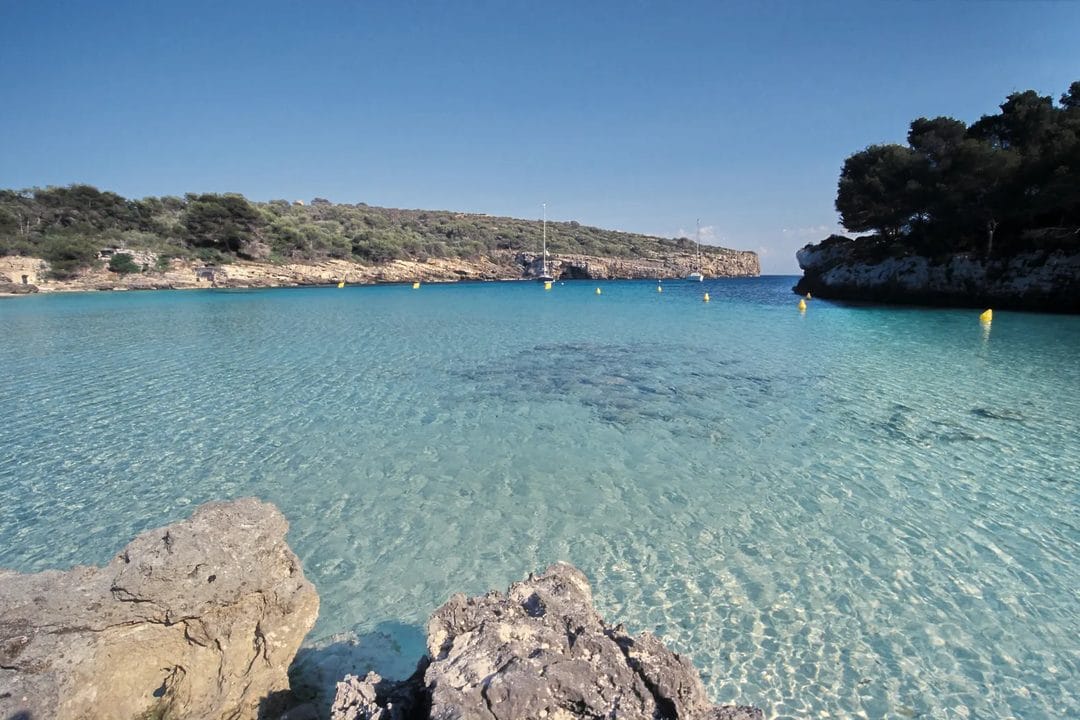
The south coast is where Menorca's postcard reputation actually lives: a run of coves — Cala Macarella, Cala Turqueta, Cala Mitjana, Cala Trebalúger — cut into pine-backed limestone, with sand pale enough to make the water look lit from underneath. None of them has a road running to the water's edge. You park in a fee-paying field fifteen to twenty minutes' walk inland (expect around €7–8 for the day) and finish the journey on foot through pine woods, which is precisely why they've stayed the way they have.
Here's the part the "quiet Menorca" pitch tends to leave out: by half past ten on an August morning, Cala Macarella's car park is full, the overflow field is filling, and the beach itself has the density of a well-attended garden party. The cove doesn't stop being beautiful. It stops being quiet. Boat charters out of Cala Galdana add to the crowd from the water side by late morning, mooring two and three deep just off the sand, so the sense of having found somewhere undiscovered evaporates fast once the sun's properly up. If you want the version of these beaches that made Menorca's reputation in the first place, you need to be parking by 8.30am, not drifting down after a leisurely breakfast. That means an early alarm on holiday, which nobody enjoys agreeing to the night before over a second glass of local wine — but it's the difference between a photograph with nobody in it and a photograph you crop carefully to avoid the family next to you. And if that sounds like too much effort, Cala en Turqueta's neighbouring, less-photographed cove, Cala des Talaier, tends to hold its calm an hour or two longer simply because fewer people know its name.
Arrive that early and the reward is considerable: turquoise water with almost nobody in it, pine shade still cool from the night, and the kind of silence that August on a Balearic island isn't supposed to offer. Bring your own shade if you can — sunbed and umbrella rental at the more popular coves runs to roughly €20–25 a day, and by midday in high summer, every umbrella on Macarella's sand is spoken for.
Walking the island's edge
The Camí de Cavalls — a 185-kilometre bridle path first laid out in the fourteenth century to let coastal watchmen patrol for pirate ships — circles the entire island and was fully restored and reopened to the public in stages through the 2000s. You don't need to walk all of it; nobody sensibly does in a single trip. The stretch between Cala Galdana and Cala Macarella takes a manageable two to three hours on foot and links four coves most day-trippers only see one of.
Cycle it instead if walking in August heat doesn't appeal — several stretches are graded for mountain bikes, and Es Grau, on the quieter east coast, rents them by the day for around €15–20. Es Grau also backs onto S'Albufera des Grau, a wetland nature park with flamingos in spring and a genuinely different Menorca: reeds, still water, birdsong instead of surf. It's the one part of the coast where nobody's selling you a sunbed.
What to eat, and what it costs
Menorca is not the cheap Balearic option.
Formatge de Maó-Menorca carries its own Denominación de Origen, made from cow's milk and rubbed with oil and paprika as it ages — buy the semicurado at eight to twelve months for the best balance, not the young stuff tourists default to. In Fornells, a fishing village on the north coast that somehow avoided the development that hit the south, order caldereta de langosta: lobster stew in a tomato-and-fish broth that most restaurants there still make properly, though at a price that reflects it — expect to pay upwards of €60–70 per head at the better-known spots, and don't be surprised if a "market price" figure isn't printed at all.
- Es Cranc in Fornells for the caldereta, if you book ahead
- Binibeca Vell's harbourside bars for a lower-stakes lunch — worth knowing that the "ancient" whitewashed village itself was actually built in 1972, designed to look centuries older than it is, which doesn't make the fish any worse
- Any bakery selling ensaimada for breakfast, and a market stall for tomatoes and Mahón cheese if your accommodation has a kitchen
Skip the seafront restaurants directly on Ciutadella's Placa des Born — the location tax is real, and better versions of the same dishes sit two streets back.
Ciutadella: the old capital that lost the title and kept the looks
Mahón became the administrative capital under British rule, largely for its harbour, and never gave the job back — which left Ciutadella, the older, western capital, free to stay beautiful without the bureaucracy. Its Gothic cathedral, built over a former mosque after the Catalan conquest in 1287, sits at the top of a warren of narrow streets that were laid out specifically to keep the summer sun off the pavement, a piece of medieval climate engineering that still works. The Placa des Born, ringed with grand townhouses, hosts the evening ritual most visitors stumble into by accident: locals arriving for a slow paseo as the heat finally breaks, ice creams in hand, no particular destination in mind.
Time a visit for the third weekend of June, if the dates ever line up with a trip, and you'll catch Sant Joan — Ciutadella's horse festival, where riders in eighteenth-century dress send Menorcan horses rearing through crowds packed shoulder to shoulder in the old town's tightest streets. It's chaotic, slightly dangerous by any modern safety standard, and exactly the kind of thing a more risk-averse tourist board would have sanitised into a parade years ago. Menorca hasn't, which is either reassuring or alarming depending on how close you're standing.
Getting there and getting around
Mahón airport (MAH) takes direct summer flights from a wide spread of UK airports — Gatwick, Stansted, Manchester, Bristol and Birmingham among them, via easyJet, Jet2 and TUI — with flight time around two and a half hours from London. Fares in August run considerably higher than the shoulder months either side; if your dates are flexible, late June or the second half of September gets you the same coves at closer to half the peak-season price, and considerably fewer people in them.
There's no real public transport network worth building a trip around, so hire a car — budget from around £45 a day in August, more if you leave it to the airport rental desks rather than booking a local company in advance. Fuel, parking at the calas, and the odd toll-free motorway toward Ciutadella are the only other costs to plan for. A UK passport needs at least three months' validity beyond your departure date for Spain, and the 90-day Schengen limit applies as it does across the rest of the EU, so check your stamps if you've been island-hopping already this summer.
Menorca isn't going to out-nightlife Ibiza or out-glamour Mallorca's west coast, and it was never trying to. What it offers instead is a working, populated island that happened to protect its own coastline before that became fashionable — Georgian windows over a Balearic harbour, gin that's been made the same way since a British garrison asked for it, and coves that reward the traveller willing to get up early enough to have them to themselves.