Bled Has Become a Queue With a Castle Behind It
By nine in the morning in the second week of August, the car parks around Lake Bled are already full, and the queue for a pletna rowing boat out to the island church stretches back along the lakeside promenade past the ice cream kiosks. This is the Slovenia most Britons have already seen on Instagram — the castle on the cliff, the green water, the single bell that newlyweds ring inside the church for luck — and it really is a beautiful spot, whatever the crowds do to it. It has also become one of the most photographed traffic jams in Central Europe, with coach parties from Ljubljana and even Munich arriving at roughly quarter-hour intervals through the whole of high season. A return pletna trip now runs to about €18 a head, and in August you'll wait forty minutes for the privilege of standing on it.
What almost nobody mentions is that Bled isn't even Slovenia's largest lake. That title belongs to Lake Bohinj, twenty-six kilometres further into the Julian Alps and sitting inside Triglav National Park itself, and it draws a fraction of Bled's numbers for reasons that have more to do with 1960s tourism marketing than anything the lake itself lacks. Bled got the royal villa, the postcard silhouette and a direct rail branch built under the Habsburgs specifically to bring visitors to its door. Bohinj got a working farming valley, a 1906 railway tunnel nobody advertised, and a somewhat useful reputation among Slovenes as the place you go precisely to avoid tourists. Go there instead this August and you trade the cliché for something bigger in every sense: a genuine Alpine lake 4.2 kilometres long, fed by glacial meltwater from the Triglav massif, ringed by peaks that don't need a filter to look the part. Locals in Bohinjska Bistrica will happily explain the difference to anyone who asks, usually within the first five minutes of conversation.
Getting There Without Ever Renting a Car
EasyJet flies direct from London Gatwick to Ljubljana, and Wizz Air runs the same route from Luton; both operate through the summer, and a return in August typically lands somewhere between £60 and £140 depending on how far ahead you book. Ljubljana Jože Pučnik Airport sits about 25 kilometres north of the capital, which already puts you closer to the mountains than to the city centre. From there, skip the temptation to book a transfer straight to Bled — go into Ljubljana bus station instead and pick up a Nomago coach heading for Bohinjska Bistrica, a journey of roughly two hours that costs around €11 one way.
The more memorable option, and the one worth building a whole afternoon around, is the train. The Bohinj Railway line from Jesenice runs through a tunnel blasted through the mountain in 1906, over 6.3 kilometres long and one of the longest in the country for most of the twentieth century, before the track drops you at Bohinjska Bistrica station with the lake still a short local bus ride away. It's slower than the coach and it doesn't pretend otherwise. Slovenian Railways runs a handful of services a day on this branch, and the fare from Ljubljana with one change at Jesenice comes in under €15.
What the Lake Itself Actually Gives You
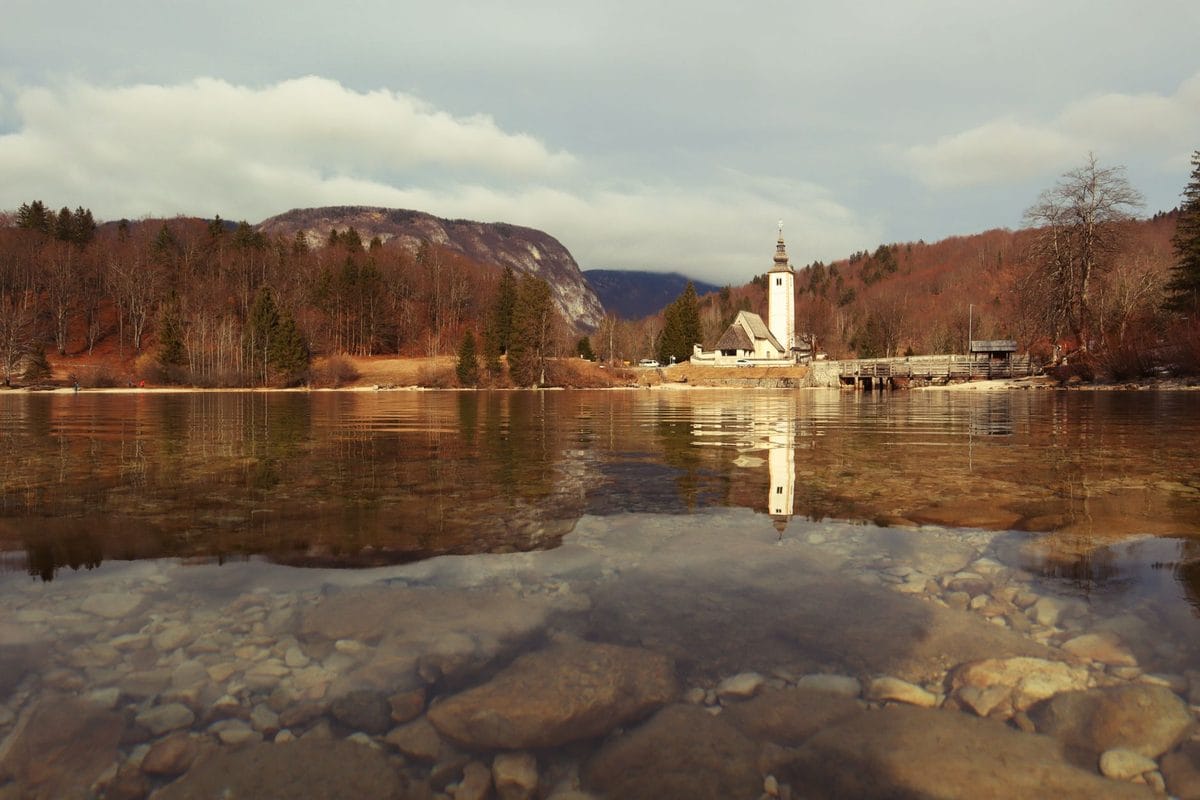
Bohinj has two working ends, and they behave differently. At Ribčev Laz, on the eastern shore where the Sava Bohinjka river flows out, there's a stone bridge, a handful of guesthouses, and the Church of St John the Baptist with fresco fragments dating back to the fifteenth century — small, unfussy, and free to look inside. At Ukanc, on the western end, the lake opens onto meadows and the base station for the Vogel cable car, with Camp Zlatorog spread along the shingle shoreline underneath. Public swimming at either end costs nothing, which on its own tells you most of what you need to know about how this lake is used compared with Bled.
- The water sits noticeably colder than Bled's, since it's fed directly by glacial run-off rather than warmed by shallow, sheltered bays.
- Rowing boats and stand-up paddleboards can be hired by the hour at Ribčev Laz for around €10–12, with nobody chasing you off the water when the hour's up.
- There's no island to row to and no bell to ring, and locals will tell you, not unkindly, that this is rather the point.
Vogel, Savica and the Walks That Justify the Detour
The Vogel cable car climbs from Ukanc to roughly 1,540 metres in under ten minutes, and the panorama from the top — the whole lake laid out below, Triglav's north face visible on a clear day — is worth the return fare of about €19 on its own. From the upper station, marked trails fan out across alpine pasture, and you can be back down inside two hours if the weather turns, which in the Julian Alps it does with very little warning. Book the first cabin up if you can manage it; cloud tends to build over the ridgeline by early afternoon in August, and the view you paid for simply isn't there by three o'clock.
Slap Savica, the waterfall that feeds the lake via an underground channel from the Triglav Lakes valley, sits a twenty-five-minute uphill walk from the car park at the head of the valley, up roughly 600 stone steps cut into the hillside. Entry costs about €3, and the water itself drops sixty-odd metres in two stages into a gorge too narrow to photograph properly from below — you simply have to stand there instead. Mostnica Gorge, a much easier half-hour loop from the farming village of Stara Fužina, does something similar at ground level: turquoise water carved through limestone, crossed by a couple of wooden footbridges, no steps required. None of this, it's worth saying plainly, is undiscovered by Slovenes themselves. Weekends in July and August bring plenty of domestic hikers up from Ljubljana, and if you're expecting total solitude you'll be disappointed — what you get instead is a lake with maybe a tenth of Bled's foot traffic, not an empty one. Turn up before nine on a weekday, though, and you'll likely have the wooden footbridges over Mostnica entirely to yourself, which is more than can be said for anywhere within an hour of Bled.
Where to Stay and What It Actually Costs
Private rooms and small guesthouses (gostišče) in Stara Fužina and the nearby village of Studor run to roughly €70–100 a night for a double in August, generally with breakfast included and a garden view of the Triglav ridge thrown in for free. Camp Zlatorog, right on the western shore at Ukanc, charges around €35–45 a night for two adults with a tent or camper pitch, and it's the better base if you want to be in the water before the day-trippers arrive from Bled. Book directly with the guesthouse where you can — several still don't bother listing on the major booking platforms, which keeps prices down but does mean an email in fairly plain English usually gets a faster reply than a booking-app message.
Food here leans hard on the valley rather than the coast, which after a week of Adriatic seafood elsewhere in Slovenia is honestly a relief. Try štruklji, rolled dumplings stuffed with everything from tarragon curd to walnut, sold at almost every guesthouse as a starter; ask for trout from the Sava Bohinjka itself rather than the farmed alternative, since most menus list both and only one of them was swimming nearby that morning; and track down mohant, a pungent, protected-designation cheese made only in this valley, which the EU granted geographical status back in 2013 and which most visitors either love immediately or can't get near a second time.
Beyond the Lake: the Vršič Pass and the Soča Valley
If you've got a hire car for a couple of days — and outside the lake itself, you do want one — the drive over the Vršič Pass connects Bohinj's side of the Julian Alps to the Soča valley on the other. At 1,611 metres it's the highest paved mountain pass in Slovenia, its fifty-odd hairpins built in 1915 largely by Russian prisoners of war, with a small wooden Russian chapel memorial still standing near the summit for the workers who died building it. The road is narrow, slow and genuinely spectacular, and it is absolutely not the route to take if anyone in the car gets carsick on switchbacks.
On the far side, the Soča river runs an almost unreal turquoise colour past Bovec and Kobarid, and it's become the base for Slovenia's whitewater industry — rafting and kayaking operators along the valley charge roughly €35–45 for a half-day trip, wetsuit included, which is considerably less than the equivalent activity costs in the Alps proper on the Austrian or Italian side. Kobarid itself carries a heavier history than its size suggests: it was the site of the 1917 battle Ernest Hemingway wrote into "A Farewell to Arms" under its Italian name, Caporetto, and the small museum in the town centre covers that campaign in more depth than the walking trails around it let on.
When to Go and How Long You Actually Need
August is peak season for Slovenian families too, since the school year here doesn't start until the first week of September, so don't expect the empty-shoreline fantasy some guides imply. What you get instead is relative peace against Bled's absolute chaos — the last week of August thins out slightly as Slovene families start the school-supplies run, and weekday mornings before ten are consistently quieter than weekends at any point in the month. Three nights is enough to do the lake, Vogel and Savica properly without rushing; four to five lets you add the Vršič Pass and a day in the Soča valley without living out of a rucksack.
Pack for both a lake and a mountain, because Bohinj insists on being both within the same afternoon. A swimming costume for the shoreline, a proper waterproof for the cable car station where the wind picks up without warning, and shoes that can handle wet stone steps at Savica — that's the whole list, and anyone who tells you they packed more than a single rucksack for this valley probably didn't need to.