The single-track road on Kalsoy ends at a gravel car park in the village of Trøllanes, and from there it is a forty-minute walk along a sheep track to reach Kallur lighthouse — a white tower perched on a ridge with a two-hundred-metre drop on either side. On a clear August morning you can see six other islands from up there, each one a jagged slab of basalt rising straight out of grey water. On a foggy one, which is more likely, you see about thirty metres of grass and a great many sheep. Either way, you will likely share the view with four or five walkers, not a coach-park queue. That is the entire pitch for the Faroe Islands in August: landscapes that would need timed entry tickets in Iceland, on an archipelago where sheep still outnumber people by roughly three to one.
Why the Faroes and not Iceland
Iceland took in close to 2.3 million visitors last year against a population of under 400,000, and it shows: Route 1 backs up at Seljalandsfoss by mid-morning in July, and Reynisfjara now posts lifeguards and barrier ropes to manage the crush. The Faroe Islands, eighteen islands strapped together by tunnels and bridges roughly midway between Scotland and Iceland, get a fraction of that traffic: around 130,000 overnight stays a year, spread across a population of 54,000. Nobody queues for a waterfall here. The landscape does the same trick as Iceland's south coast — sheer green cliffs, sea-falling waterfalls, turf-roofed churches, a pale gold light lasting from five in the morning to gone nine at night — without the ring-road traffic or the £20 car parks that have sprung up outside every famous waterfall in Iceland. Go to the Faroes first and save Iceland for the shoulder season, when its own crowds have thinned out. That order gets you the more dramatic scenery while it still feels undiscovered, rather than working backwards from a place you have already seen flooded with camper vans.
Getting there from the UK
Atlantic Airways runs a seasonal direct route from Edinburgh to Vágar, the Faroes' only airport, from roughly April to September — under two hours in the air and by far the simplest way in from Britain. Fares start around £220 return booked early, but by July and August £350–£450 return is closer to reality. The alternative is flying via Copenhagen with SAS or Atlantic Airways, which runs year-round, but adds a layover and a full extra leg.
Book the Edinburgh route over the Copenhagen connection whenever the dates line up. A missed connection through fog-prone Kastrup can cost a full day of a five-day trip, not the hour it looks on the itinerary.
What August actually feels like
Average highs sit at 12–13°C, with lows around 9°C, and rain gear is not optional — pack a proper waterproof shell and boots with grip, not a fashion mac. Wind is the bigger factor: gusts across the Kalsoy ridge or the Vestmanna cliff path can knock you sideways even on a dry day, and locals judge a good day by wind speed more than rainfall. Fog is the one that catches visitors out. It can ground the government-subsidised inter-island helicopter (from about £25 a leg, book weeks ahead) and cancel the Vestmanna and Mykines boat tours with little warning, so build one spare day into any August itinerary rather than flying home the same evening as your last excursion. The reward is the light: at this latitude the sun clears the horizon before five and does not set until gone half nine in early August, giving photographers a long, soft evening no Mediterranean resort can match in high summer. Pack in layers rather than for one expected temperature — a fleece, a windproof shell and dry spare socks matter more than anything rated for genuine cold.
The sights that justify the trip
None of them are more than a short drive from a paved road, and that is precisely the point.
Tórshavn's old town and its restaurant scene
Tinganes, the wooden-housed peninsula where the Faroese parliament has sat since the Viking age, takes about twenty minutes to walk end to end, which tells you most of what you need to know about the scale of the capital. What it lacks in size it makes up in food: Áarstova serves slow-cooked lamb in a two-hundred-year-old timber house for around £35 a main, and KOKS, the archipelago's Michelin-starred tasting menu, runs from roughly £250 a head if you can get a table at all.
Saksun and the vanishing tide
Saksun sits around a tidal lagoon that was a proper harbour until a storm sealed it off with sand in the eighteenth century; at low tide it looks like a Highland loch, and at high tide the sea creeps back in over the flats. The turf-roofed church above the water is one of the most photographed buildings in the country, and deservedly so.
Gásadalur and the waterfall that falls into the sea
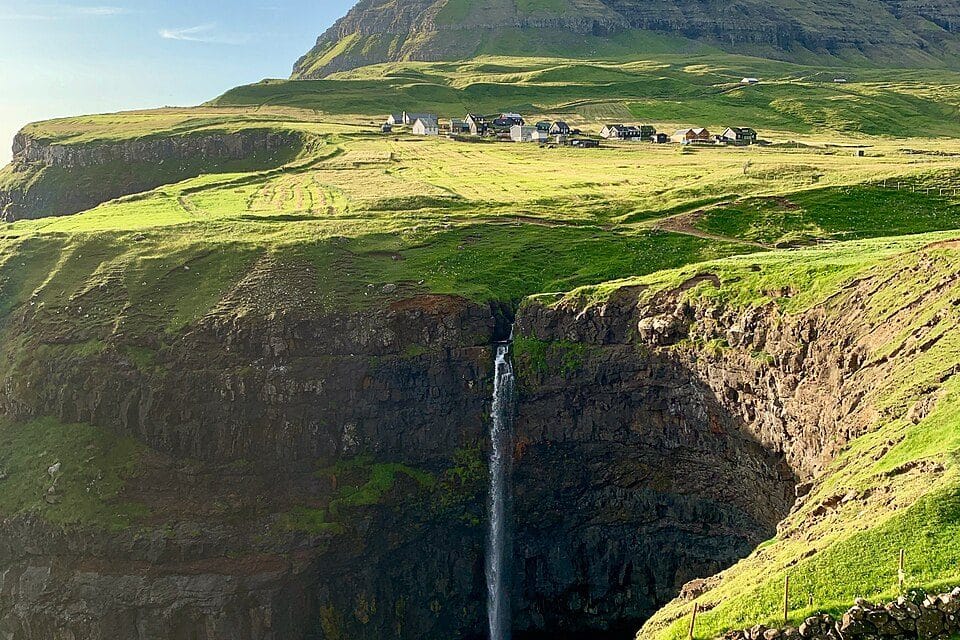
Múlafossur drops straight off a cliff edge into the Atlantic beside the tiny village of Gásadalur, which had no road at all until a tunnel was cut through the mountain in 2006 — before that, the thirty-odd residents reached the outside world on foot over a 400-metre pass or by helicopter. The viewpoint itself is a five-minute walk from the car park, which makes it one of the least effortful iconic shots in the whole country.
Kalsoy, the lighthouse, and the Bond effect
Kalsoy reached a wider audience in 2021 as a filming location for No Time to Die, and the ferry from Klaksvík now sometimes needs booking a day or two ahead in peak season. The hike to Kallur lighthouse described above is roughly 3km round trip and manageable for most fitness levels, though the drop-offs either side of the ridge are unfenced and need respecting in wind.
The lake that floats above the ocean
Sørvágsvatn, also called Leitisvatn, sits on a plateau that ends in a sheer 30-metre drop straight into the sea, and the angle from the Trælanípa viewpoint makes the lake appear to hover above the waves rather than sit beside them. It is an optical trick, not actual physics, but it photographs exactly as the postcards promise. The circular walk from the car park near Miðvágur runs about 5km and crosses private land, so there is a small trail fee collected on site or online in advance.
Vestmanna's bird cliffs — and the puffin catch
The boat trip past the Vestmanna sea cliffs runs about two and a half hours and costs roughly £45–£55, weaving into sea caves beneath nesting kittiwakes, guillemots and fulmars. Here is the catch nobody mentions in the brochures: Atlantic puffins mostly abandon their burrows for open sea by the second week of August, so a trip booked for late in the month can mean paying full price for empty ledges — the puffin photos on the operator's website were clearly taken in June. Travel in the first ten days of the month if puffins are the reason for the trip at all — after that, Mykines and Vestmanna are worth it for the cliffs and the other seabirds, not for the puffins.
Subsea tunnels and hiring a car
Two undersea tunnels have quietly reshaped how the islands connect: the Eysturoyartunnilin, opened in December 2020 with the world's first undersea roundabout, links Streymoy to Eysturoy, and the Sandoyartunnilin, opened in December 2023, connects Streymoy to Sandoy. Both charge a toll automatically by number-plate recognition — no barrier, no ticket booth — with rental companies typically billing the charge afterwards, usually £12–£18 per crossing depending on the tunnel and vehicle size.
- Hire a car for the whole trip rather than relying on buses from a Tórshavn base — a small manual runs £60–£85 a day in August, which is peak season, and the fleet across the entire country is small enough that waiting until the month before to book often means nothing is left.
- The public Bygdaleið bus network is cheap, around £3–£5 a journey, and covers the main road corridor well.
- It does not reach the Kalsoy ferry jetty, the Trælanípa car park, or Saksun on a useful schedule, among other trailheads, particularly on Sundays, when services thin out drastically.
- Taxis exist between villages but run to £35–£40 a trip, which adds up fast across a five-day itinerary.
Where to stay and what it costs
Hotel stock is genuinely tiny — Tórshavn has barely a dozen proper hotels, and the whole archipelago fills up fast around Ólavsøka, the national holiday on 28–29 July, whose bookings spill into early August. Hotel Føroyar, above the capital with sea views from most rooms, runs £140–£190 a night for a double in August; Hotel Streym in the harbour area is a little cheaper. Guesthouses and Airbnbs in villages such as Gjógv or Elduvík go for £70–£110, and a dorm bed at Bládýpi Hostel starts around £35. Book three to four months ahead for August — leaving it to June means whatever is left, and a much longer drive each morning.
A five-day plan that actually works
- Land at Vágar, collect the hire car, and drive straight to Gásadalur and Múlafossur before the afternoon fog rolls in; stop at Trælanípa on the way back for the floating-lake view, then overnight in Tórshavn.
- Spend the morning in Tinganes and the harbour, then take the early Vestmanna boat tour — book this one in advance, since it is the excursion most likely to sell out or get weather-cancelled.
- Drive north through the Eysturoyartunnilin to Klaksvík, catch the ferry to Kalsoy, and walk out to Kallur lighthouse.
- Visit Saksun in the morning and the black-sand village of Tjørnuvík in the afternoon, then eat at Áarstova back in the capital.
- Keep this as a genuine buffer day for fog or wind cancellations from earlier in the week, or, if everything ran on schedule, take the short ferry out to Nólsoy before the evening flight home.
The paperwork non-event
Here is the one piece of good news in all this planning: the Faroe Islands sit inside the Kingdom of Denmark but outside both the EU and Schengen, so none of the new Entry/Exit System or ETIAS rules complicating summer travel to the Continent apply here. A UK passport valid for the length of the stay is all that is needed, with no visa, no 90-day counter, and no biometric kiosk on arrival. The currency is the Faroese króna, pegged one-to-one with the Danish krone and used interchangeably with it; contactless card payment is close to universal, even at remote farm shops and unmanned honesty-box stalls, so there is little reason to carry cash beyond a note or two for the rare machine that only takes coins.
Book the flights and the Vestmanna boat first, then build everything else around whatever the weather does — because on Kalsoy in August, the weather, not the ferry timetable, is what actually decides your day.