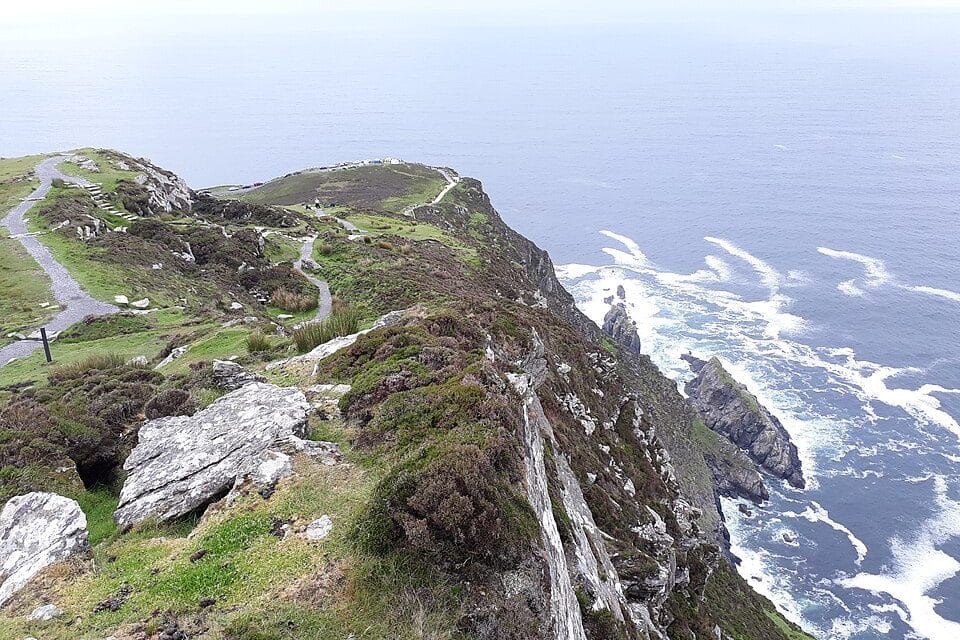
Stand at the car park below Slieve League on a clear August morning and the cliffs do something odd to your sense of scale: they make the Cliffs of Moher look modest. At 601 metres, Slieve League rises nearly three times the height of Ireland's most photographed sea cliff, and yet on a Tuesday in high summer you might share the viewing point with a dozen people rather than a coach park's worth of them. That gap between the scale of the place and the size of the crowd is the entire case for County Donegal, the wedge of Ireland's north-west that most first-time visitors fly straight past on their way to Killarney or Galway.
Why Donegal beats the departure board this August
Michael O'Leary spent the spring warning that this would be a messy summer for European air travel, and he was not wrong. French air traffic control strikes have been cancelling flights that never even cross French airspace, ground staff disputes have flared in Spain and Belgium, and Ryanair, easyJet, Vueling, Wizz Air and Volotea have all been quietly trimming capacity on strike-prone routes rather than risk last-minute chaos. The knock-on effect catches travellers off guard more often than the strikes themselves: an air traffic control walkout in France hits the airspace, not just the airports, so a flight from Manchester to Palma can be cancelled purely because its usual routing would have crossed French skies. None of that touches a car boarding a ferry at Cairnryan. Ireland also sits outside the Schengen Area entirely, so the EU's new Entry/Exit System — the fingerprint-and-photo kiosks now slowing down arrivals at Calais and Charles de Gaulle — simply doesn't apply here. You show a passport at the ferry desk, not a biometric terminal.
Skip the connecting flight through Dublin and take the ferry instead — it's the better way into this corner of Ireland, not merely the cheaper one. Stena Line's Cairnryan–Belfast crossing takes about two hours fifteen minutes, runs up to twelve times a day, and a car with two passengers typically costs somewhere between £135 and £290 one way depending on the sailing (fares are dynamic, so book a few weeks ahead if you can). From Belfast it's roughly two and a half hours' driving to Donegal town, most of it on quiet A-roads through Fermanagh. P&O's Cairnryan–Larne route is a shorter crossing at around two hours and lands you slightly further north. Either way, you're driving into Donegal with a full boot and no gate number to worry about.
Slieve League, without the coach park
The cliffs themselves are reached by a well-surfaced road from Teelin, ending in a car park with a small visitor centre and, on a good day, sheep grazing right up to the fenced viewing platform. From there it's a couple of kilometres on foot to the 601-metre summit, with the path gaining height gently enough that most reasonably fit walkers manage it without technical gear. Boat trips run from Teelin harbour too, taking you underneath the cliffs rather than along their top — a different, arguably better, way to grasp how sheer they actually are.
Unless you're an experienced hillwalker, stop at the main viewing point and treat that as the full visit. Beyond it, the path deteriorates into the Pilgrim's Path and eventually One Man's Pass, a ridge barely wider than a single boot with a drop on both sides, and fog can roll in off the Atlantic in minutes even in August. It is genuinely spectacular for people with the right experience and boots, and genuinely dangerous for people without either — Donegal Mountain Rescue and the coastguard both list it among their busiest call-outs, and the advice locally is blunt: if you can't see the next waymarker, turn back rather than guess. Emergency number here, as everywhere in the Republic, is 999 or 112.
Glenveagh, where the golden eagles came back
An hour's drive north, Glenveagh National Park sits in the Derryveagh Mountains around Lough Veagh, and it's the most northerly of Ireland's six national parks. Glenveagh Castle, a turreted Victorian retreat built between 1867 and 1873, once hosted guests including Marilyn Monroe and John Wayne, and now draws around 200,000 visitors a year for guided tours that run until the last one at 16:45. Admission to the park and its gardens is free; only the castle tour itself carries a charge. The land the estate sits on was bare mountain moorland before any of this existed — the castle went up first, from 1869, and the gardens followed in the mid-1880s, which is easy to forget while standing under mature rhododendrons that look as if they've always been there. The gardens are the quieter draw for most people who make the trip — a Tuscan garden, an Italian terrace and a flight of stone steps known locally as the 67 Steps, all expanded through the mid-twentieth century by the American philanthropist Henry P. McIlhenny with help from garden designers Jim Russell and Lanning Roper.
The visitor centre is a further four kilometres from the castle by shuttle bus, or a 3.5-kilometre walk if you'd rather see the Derryveagh Mountains at ground level. Red deer graze openly in the park, and it's one of the few places in Ireland where golden eagles — reintroduced here after more than a century's local absence — are occasionally visible overhead. Book the guided castle tour rather than wandering the self-guided route; the guides know which rooms held which guest and why the gardens were laid out the way they were, and that context is most of what makes the visit worth the detour from the coast road.
Malin Head and the edge of the map
Keep driving north past Glenveagh and the roads narrow further until they run out entirely at Malin Head, the most northerly point on the island of Ireland. A disused Napoleonic-era signal tower stands at Banba's Crown, the headland's highest point, and the view on a clear day takes in nothing but Atlantic until Iceland. Star Wars fans will recognise the same clifftop from a handful of shots in The Last Jedi, filmed here during a brief window when the production took over the local roads and half the village of Malin turned out to watch.
Errigal, Donegal's most distinctive mountain, is on the way if you're coming from Glenveagh — a quartzite cone that catches pink light at dawn and is popular enough with hillwalkers that the car park at its base fills by mid-morning in August, so go early or not at all.
Arranmore, fifteen minutes off the coast
From Burtonport, two ferry operators run boats out to Arranmore Island every few hours, with the crossing itself taking only fifteen to twenty minutes. A foot passenger return costs around €15, a car around €30, and both vessels are licensed to carry up to 96 passengers with an indoor cabin for wet crossings (this is Donegal in August, not the Algarve — pack a waterproof). Buy a foot-passenger ticket rather than bringing the car across unless you're staying overnight; Arranmore is small enough to walk in an afternoon, and the island's few roads are better suited to the bicycles some of the guesthouses lend out anyway.
What's actually on the island is a scattering of white cottages, two working pubs, a scenic loop road with views back to the mainland cliffs, and — for anyone who's come this far — a population that's used to weekend day-trippers but not yet used to crowds.
Money, beds and the practical bits
The exchange rate has been kind to UK visitors this summer: sterling has been trading close to a one-year high against the euro, around £1 to €1.17 through late July, which takes some of the sting out of paying in a different currency to Northern Ireland just across the border. Bed and breakfast rates in Ardara and Glencolmcille, the two small towns closest to Slieve League, generally run from about €90 a night for a double — noticeably less than the €150-plus routinely asked for equivalent rooms in Killarney or Galway during August.
Stay in Ardara or Glencolmcille rather than basing yourself in the county town of Letterkenny. Both are within twenty minutes of Slieve League, both have pubs doing food until late, and neither requires the car once you've parked for the evening. Donegal town itself is worth an afternoon rather than a base, mostly for Magee 1866, the tweed weaver that's been working out of the same building on the Diamond since 1866 and still sells off-the-loom jackets rather than the mass-produced version found in Dublin gift shops.
- Ferry: Stena Line Cairnryan–Belfast (2h15, up to 12 daily) or P&O Cairnryan–Larne (around 2h)
- Flying in is possible too — Donegal Airport at Carrickfinn has an Aer Lingus Regional service to Dublin twice a day, though the connection onward from Dublin adds hours most drivers skip by going direct from Scotland
- Currency: euro, not sterling, the moment you cross from Northern Ireland into the Republic
- Pack for all four seasons in one afternoon, because the forecast changes that quickly on this coast, and bring a torch if you're staying anywhere rural — streetlighting more or less ends at the edge of the villages
None of this requires a passport check at a biometric kiosk, a strike-watch app, or a second mortgage on accommodation. It requires a car, a ferry booking, and a willingness to drive further north than most people think Ireland goes.