By nine in the morning the beach at Gjipe is still in shadow, the limestone cliffs on either side holding back the sun for another hour, and there is nobody on the sand except a fisherman untangling a net and a dog asleep by an upturned boat. This is Albania's southern coast in October — a strip of Adriatic and Ionian shoreline that, three years ago, barely registered on a British traveller's map and now turns up in the same sentence as Croatia, minus the crowds, the cruise ships and, for the moment, the prices.
Why the neighbours are suddenly full
Croatia and Greece didn't get more crowded by accident — their own governments have spent the past two years actively squeezing the volume, which has pushed the overflow somewhere else. Dubrovnik now caps cruise arrivals at two ships and roughly 4,000 visitors inside the Old Town walls at any one time, down from the free-for-all that saw over 800,000 cruise passengers land there in a single year before the limits went in. Santorini went further: an 8,000-passenger daily cap on cruise arrivals plus a €20 landing levy, reintroduced and actually enforced from 2025 onwards, after peak days had been running north of 15,000 people disembarking onto an island that measures barely 16 miles end to end. Hvar's town council still fines visitors for walking around off-beach in swimwear — a rule that sounds like a joke until you're the one being stopped by a municipal officer at 11am in a bikini and a pair of flip-flops.
None of that has made Croatia or Greece unpleasant, exactly. It's made them expensive, regulated and increasingly booked out well before the shoulder-season window that used to be the insider's move. Albania, sitting directly across the water from Corfu with almost identical light, similar limestone coastline and a fraction of the name recognition, has absorbed a good chunk of the travellers priced or crowded out of both. Ksamil's beach bars were mostly Italian and Kosovar Albanian custom five years ago; this September they were unmistakably full of German, Polish and British accents too.
What October actually looks like on the ground
The sea along this coast holds its summer heat far longer than the Aegean does, largely because the water here is shallower and the current patterns keep it warmer into fifth week. Daytime air temperatures through October typically sit in the low-to-mid twenties Celsius, dropping into the mid-teens after dark, and the sea itself stays swimmable — genuinely swimmable, not "brave it for the photo" swimmable — through most of the month, often into early November around Ksamil's lagoon islands. Ksamil itself is the postcard: four small islands close enough to wade or swim between, turquoise water that looks digitally enhanced in photographs but isn't, and a village behind it that has grown almost entirely around tourism in the last decade.
Saranda, twenty minutes up the coast, is the bigger town and the one most people land in first — a proper working seafront with a promenade, restaurants stacked three deep and a slightly chaotic energy that some visitors love and others find exhausting after a day. Himarë and Dhërmi, another forty minutes north along the coastal road, are the quieter alternative: smaller settlements, pebble-and-sand beaches backed by the Ceraunian Mountains, and by October most of the summer's beach-club crowd has gone home, leaving genuinely local tavernas serving grilled fish that was swimming that morning. Stay in Himarë rather than Saranda town if peace matters to you more than nightlife — Saranda in high season is loud, and even in October it hasn't fully quietened down.
Getting there is still the whole point
This is the part that keeps the coast from filling up the way Croatia did, and it isn't going to change as fast as the Instagram posts suggest.
Tirana International Airport is the obvious entry point, with Wizz Air flying from Luton and easyJet from Gatwick, one-way October fares typically running £40–£90 depending on how far ahead you book. The catch is what comes after landing: it's a three-and-a-half to four-hour drive south to the Riviera, on roads that are perfectly fine but slow, winding through mountain passes that no sat-nav estimate quite accounts for. The alternative most seasoned visitors actually prefer is flying into Corfu — served from several UK regional airports through most of October before winter schedules cut in — and then taking the Finikas Lines or Ionian Seaways hydrofoil across to Saranda, a crossing of about 25 to 40 minutes depending on the vessel, for roughly €25–€35 one way. It's faster, it's more scenic, and it skips the drive entirely. Book the Corfu ferry over the Tirana-and-drive route if your schedule allows it; the time saved is real and the Corfu Town stopover is no hardship.
Vlora International Airport, meant to be the shortcut that put the southern Riviera a twenty-minute drive from a runway, was still not handling commercial flights as of this autumn despite a first certification flight back in May 2025 and a string of "opening this summer" announcements that have now missed two consecutive summers. Tour operators who built 2025 packages around it had to quietly redraw their transfer logistics when the flights didn't materialise. Whenever it does open — and Albanian government messaging keeps saying "soon" — it will cut the access problem that currently protects this coast from a Dubrovnik-style influx, so the honest advice is to go now, while getting here still requires enough effort to filter out the day-trip crowd.
Beyond the beach: three stops worth the detour
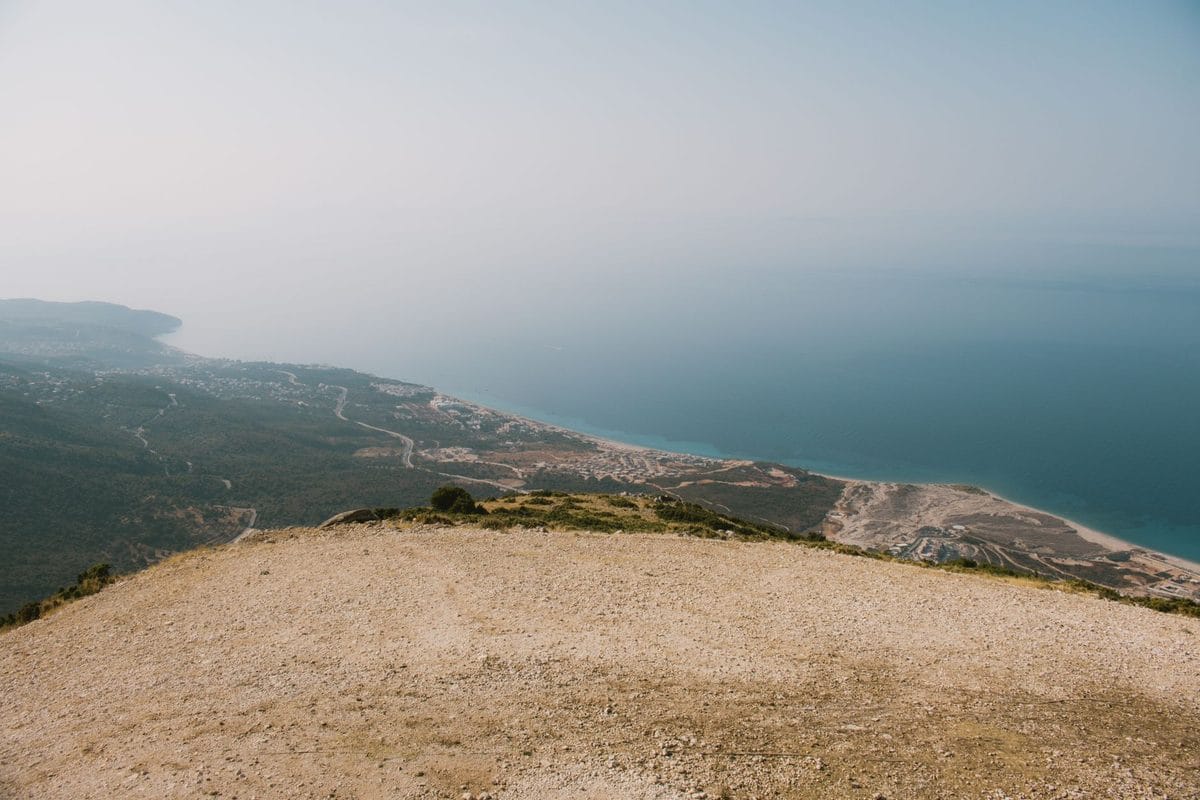
The coast isn't the only reason to come in October, and treating it as a pure beach trip misses most of what makes the region interesting. The Blue Eye spring (Syri i Kaltër), about 40 minutes inland from Saranda, pushes cold, startlingly clear water up from a depth divers still haven't fully mapped — swimming in it is genuinely bracing even in October heat, and it costs a few euros to enter. Butrint, a UNESCO-listed archaeological site near the Greek border with layered Greek, Roman, Byzantine and Venetian ruins, gets a fraction of the footfall that Ephesus or Delphi draw despite being comparably significant, largely because most package tourists never make it this far south. And the Llogara Pass, the mountain road connecting the Riviera to Vlorë further north, climbs to over 1,000 metres with hairpin bends and a viewpoint that looks straight down onto Dhërmi's beach from a height that makes the turquoise water look almost unreal — worth the drive even if you're not continuing north.
What things actually cost
This is where the comparison to Croatia stops being abstract. A full seafood dinner for two in Himarë or Dhërmi — grilled sea bream, a Greek-style salad, a litre of house wine — runs €25–€35 total at most tavernas, against €60–€80 for the equivalent in Dubrovnik's Old Town. A double room with a sea view in a family-run guesthouse in Ksamil in October books for €35–€60 a night; the same view in Santorini in high season starts well north of €200. Even allowing for the fact that Albania's coast is objectively less developed — fewer boutique hotels, patchier Wi-Fi in the smaller villages, cash still preferred over cards in a fair number of tavernas — the gap is large enough that a week here costs meaningfully less than a long weekend in Croatia's honeypot towns.
The catch nobody puts in the brochure
None of this is a spotless story. A number of the best stretches of beach along the Riviera have been quietly fenced off by private sunbed operators who pay local authorities for the concession and then charge €15–€25 a day for a lounger on sand that is, legally, public — a practice that predates the tourism boom but has intensified as the money coming in has grown. Waste collection in some of the smaller villages hasn't scaled with the summer population, and a walk along parts of the coastal path between Dhërmi and Himarë in August turns up rubbish that would be unthinkable on an equivalent stretch of the Croatian coast. October is kinder on both counts simply because there are fewer people generating the mess in the first place, but it's worth going in with eyes open rather than expecting the postcard to hold up in every direction you look.
EU accession and the closing window
Albania has been a formal EU candidate since 2014 and opened accession negotiations in 2022, with Tirana's own government repeatedly floating 2030 as a target for membership — a date most Brussels-watchers treat as optimistic rather than fixed, given how long Balkan accession processes have historically dragged. What membership would actually change for a British visitor is less dramatic than it sounds: easier onward road links, EU infrastructure funding likely aimed at exactly the kind of airport and road projects the Riviera currently lacks, and — eventually — the kind of price convergence with the rest of the Adriatic that has already happened in Croatia since it joined in 2013. None of that arrives quickly. But the direction is set, and every year that passes without Vlora Airport opening or EU funding landing is another year this coast stays cheaper and quieter than the alternative eighty miles across the water.
Go for October specifically if the choice is between this and next summer. The sea is still warm, the beach-club scaffolding of August has come down, and the coastal road between Saranda and Dhërmi — thick with rental cars and tour buses through July — empties out enough that you can actually pull over at the viewpoints without queuing for the parking space.